

Elucidating structure-property relationships in strongly-coupled chromophore-radical dyads
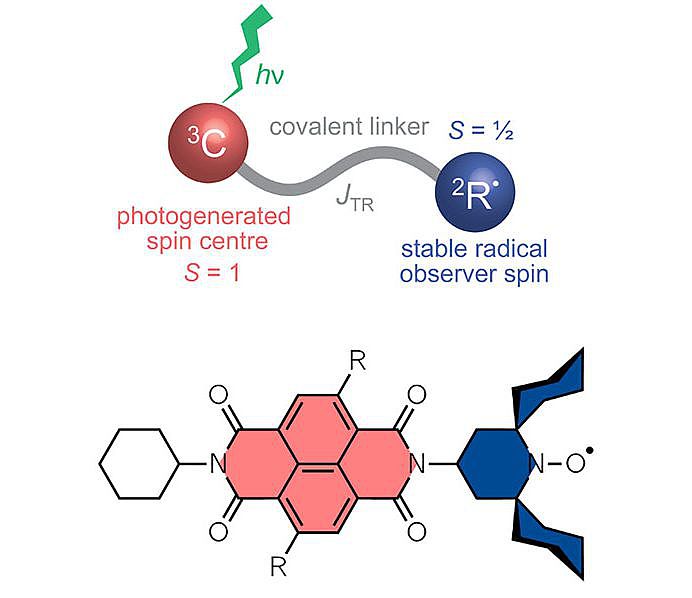
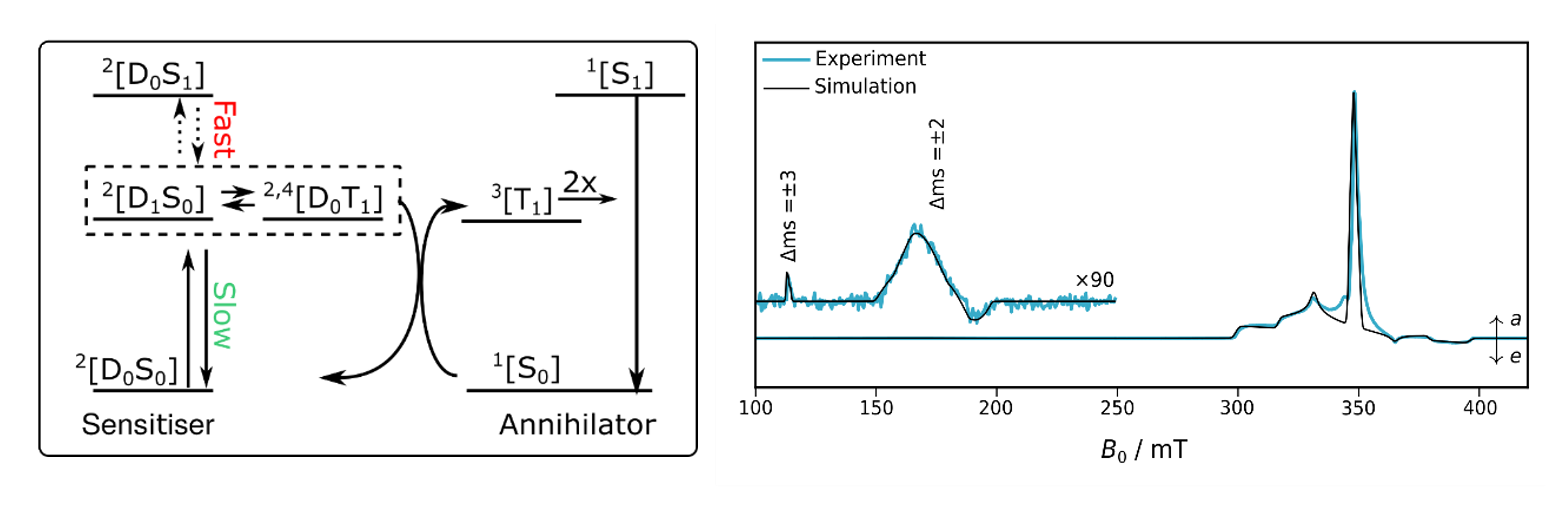
Molecular assemblies consisting of a chromophore, a linker and a stable radical may form multi-spin systems upon photoexcitation. Because of their modular nature, these molecules provide a versatile model platform to investigate structural influences on spin spin interaction and the properties of high spin states. To elucidate the photophysics and the role of electron transfer for high spin state generation, we investigate a series of core-functionalised naphthalene diimides (NDIs), which are covalently linked to a stable nitroxide radical, by optical ultrafast techniques and transient EPR spectroscopy.
Beyond the scope of covalently bound chromophore-radical dyads, we investigate non-covalently bound chromophore-radical systems, including hydrogen-bonded and bimolecular assemblies.
References:
Quintes, T.; Mayländer, M.; Richert, S. Properties and applications of photoexcited chromophore-radical systems. Nat. Rev. Chem. 2023, 7, 75-90.
Khariushin, I.; Thielert, P.; Zöllner, E.; Mayländer, M.; Quintes, T.; Richert, S.; Vargas Jentzsch, A. Supramolecular dyads as photogenerated qubit candidates. Nat. Chem. 2025, 17, 493-499.