

Project Background
About 75% of children and adolescents in child welfare programs report having experienced at least one traumatic event, such as physical violence, experiences of abuse or neglect. Consequently, children can develop trauma-related disorders such as the posttraumatic stress disorder or show other psychological distress such as sadness, anxiety or insecurity. Early treatment can help prevent further difficulties and reduce the psychological distress of children long-term. However, in reality, the affected children only have limited access to evidence-based trauma treatment. Therefore, the research project “CBITS -Treat Trauma in Child Welfare” aims to provide traumatized children and adolescents in child welfare programs with access to a trauma-focused intervention. Through this project, the trauma-focused group intervention CBITS will be scientifically evaluated and sustainably integrated into regular care.


What is CBITS?
CBITS - "Cognitive Behavioral Intervention for Trauma in Schools" is a trauma-focused group intervention that addresses the issues of trauma and anxiety. The programme uses cognitive behavioural therapy methods and is specifically tailored to the needs of children and young people who have experienced trauma. With the help of the intervention, affected children and adolescents learn techniques that support them in dealing better with stressful thoughts, feelings and memories. The intervention consists primarily of group sessions which are combined with individual sessions. The intervention is conducted by trained child and youth psychotherapists in training.
Project Description
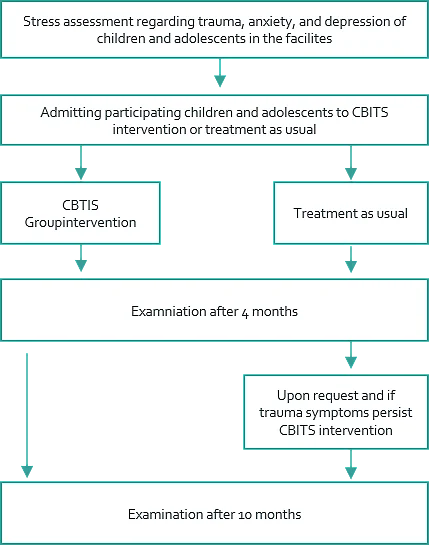
The effectiveness and feasibility of the group intervention CBITS will be evaluated in a randomized controlled trial (RCT) in 3 study regions (Marburg, Bochum, Ulm) with a total of 9 cooperating child and youth welfare programs and 3 study centers (training centers for behavioral therapy). The primary outcome measure is a reduction of posttraumatic stress symptoms, which will be assessed before and after the intervention as well as at a 6 months follow-up by standardized screening on site. A total of 90 children and adolescents between 8 and 16 years, who are in a child welfare program and who exhibit corresponding trauma symptomatology, will be included in the study. For the implementation of the intervention, a total of 24 therapists will be trained and closely supervised in cooperation with the authors of the intervention in the USA.
The group therapy consists a total of 10 group sessions (45 minutes each) and 1-3 individual sessions per participant. In addition, there are at least 1-3 appointments for the child welfare staff. All children and adolescents enrolled in the study will receive feedback regarding psychopathological abnormalities (e.g. depression, PTS, anxiety).
What do the results show?
The results show that post-traumatic stress symptoms, depression, anxiety, and anger reactions decreased over the course of the intervention. The positive development of post-traumatic stress symptoms in the intervention group also continued over the longer term. At the same time, the control group also showed improvements. Therefore, no clear differences in effectiveness were found between the two groups.
The study demonstrated the feasibility and acceptability of CBITS within the German child and youth welfare system. The outreach-based approach could be integrated into existing structures and was positively evaluated by both therapists and child welfare professionals. Close collaboration between CBITS therapists and child welfare professionals emerged as an important factor for successful implementation.
These findings support embedding trauma-focused services more strongly within existing child welfare care structures. Both therapeutic support and close collaboration with professionals working directly with children and adolescents are central to this approach.