


Single cell sorting

Single cell sorting is a method for isolating cells or other biological entities based on fluorescence or morphological features. In this process, specific proteins (surface markers, intracellular proteins, transcription factors, etc.) of a cell are visualized using fluorescently labelled antibodies.
This method is based on flow cytometry technology with the addition that defined cells can be sorted out from the population. The cells are individually packed into small liquid droplets, deflected into different positions based on different charges, and sorted individually into collection vessels.
This technology is also used for sorting cells expressing fluorescent proteins (GFP, RFP ...) after genetic modification.
Equipment

BD FACSAria III
13+2 channels
5 lasers:
- Blue (488 nm)
- Green-Yellow (561 nm)
- Red (633 nm)
- Violet (405 nm) or
near-UV (375 nm)

BD FACSAria II SORP
12+2 channels
4 lasers:
- Blue (488 nm)
- Red (640 nm)
- Violet (405 nm)
- UV (355 nm)

BD FACSAria III
10+2 channels
4 lasers:
- Blue (488 nm)
- Red (633 nm)
- Violet (405 nm) or
near-UV (375 nm)
Accessories


Collection holders
Tubes (2-4 populations)
PCR Tubes
EppendorfTM Tubes (1.5ml, 2ml)
FACS Tubes
15ml Tubes
Individual Tubes
Plates (1 population)
384-well plates
96-well plates
48/24/12/6/4-well plates
Terasaki plates
Slides
Individual plates
Setting options
Nozzle sizes: 70 µm, 85 µm, 100 µm, 130 µm
The nozzle used for sorting is adapted to the cell or particle size.Aerosol Management Option (AMO)
The AMO enables the safe sorting of biological material, as aerosols are extracted directly.Temperature: 4°C, RT
The temperature of the sorting process can be optimized according to the cell type and the downstream application after the sort.Index sorting
Each cell placed in a well can be retrospectively identified on the DotPlot.
More Information
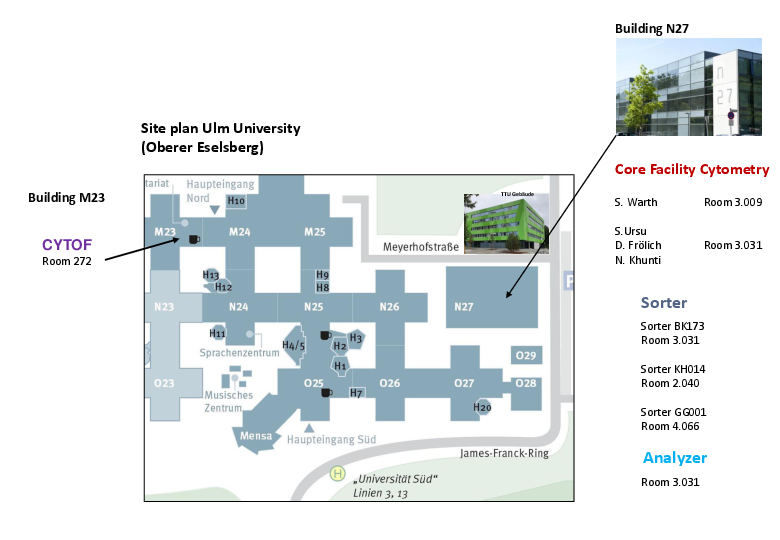
Our Core Facility equipment can be found at the following locations:
| BD FACSymphony™ A1 | N27, 3rd floor, R3.031 |
| Sorter FACSAria III KH014 | N27, 2nd floor, R2.040 |
| Sorter FACSAria III BK173 | N27, 3rd floor, R3.031 |
| Sorter FACSAria II GG001 | N27, 4th floor, R4.066 |
| Mass Cytometer: CyTOF (Helios) | M23, 2nd floor, R272 |