


Post-Doc: Reinforcement Learning for Neuromodulation
Application Deadline (extended) : 15.9.2026
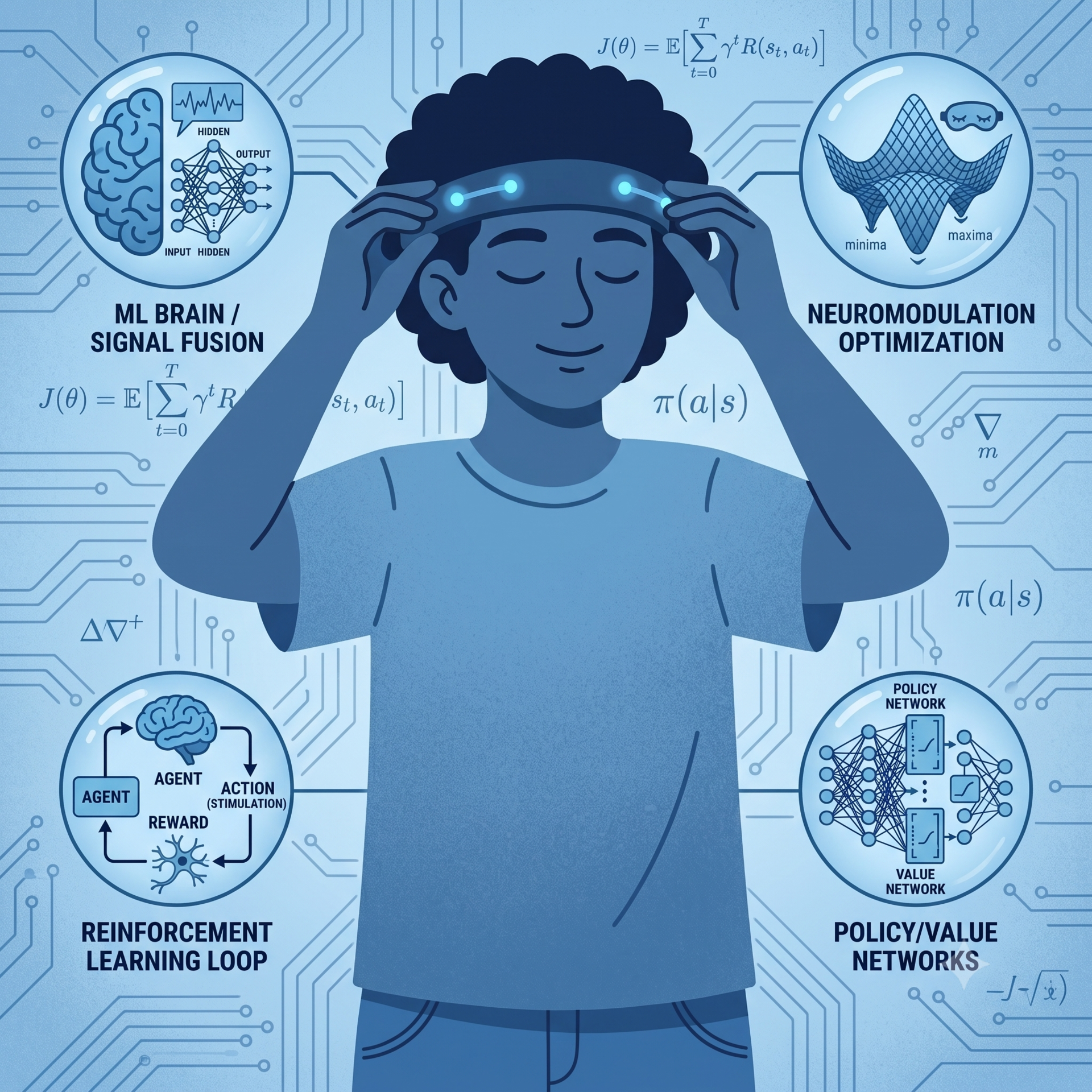
The Institute of Biomedical Engineering conducts research at the intersection of medical wearables, artificial intelligence, and remote health monitoring, driving innovation to improve patient outcomes. With this position funded through the Volkswagenstiftung, we are expanding our research into real-time personalized interventions using wearable electroencephalogram (EEG) during sleep. Our goal is to pioneer developments in wearable technology that integrate reinforcement learning to discover novel strategies for human interaction and uncover yet unknown physiological particularities of sleep and other human health factors.
Your Profile
- PhD (or near completion) in Biomedical Engineering, Computer Engineering, Computer Science, or a closely related field.
- Strong theoretical background in machine learning with proven experience in applying reinforcement learning to practical, applied problems.
- A clear interest in human health, wearable sensors, biosignals, and sleep physiology.
- Excellent problem-solving abilities, with a demonstrated capacity to contribute to cutting-edge research, secure external funding, and effectively disseminate findings.
- Outstanding communication skills (written and verbal) in English; proficiency in German is considered a strong asset.
- Experience in teaching and supervising students at the undergraduate and/or postgraduate level.
- A collaborative, team-oriented mindset with the interpersonal skills required to guide students and work effectively within a multidisciplinary research and health science environment.
Your Responsibilities
- Conduct pioneering research in the design and implementation of reinforcement learning within a real-time context, specifically addressing and overcoming sample efficiency challenges.
- Lead and mentor a small team of researchers in developing innovative technological solutions to be translated into human experiments.
- Disseminate research findings through high-quality peer-reviewed publications, top-tier conference presentations, and other scholarly outputs.
- Contribute to securing third-party funding to actively support and expand the research group's portfolio.
We Offer
- A unique opportunity to shape and lead an innovative research direction within the institute and the broader university community.
- Close collaboration with leading academics and recognized experts in wearable technology, machine learning, and sleep research.
- Excellent infrastructure, providing state-of-the-art wearable and computational resources to drive your research rapidly forward.
- Strong translational support and facilities, including MDR: bring medical technology fast into clinics and to patients.
- A vibrant, supportive, and collaborative working environment within a dynamic and expanding research team.
- An interdisciplinary setting that actively fosters cutting-edge, innovative research across engineering and medicine.
- Strong prospects for academic growth and long-term career development.
- A competitive salary, aligned with German university pay scales (TV-L) and institutional regulations.
Please apply in our application portal until the 15th of September! For further information please contact: Prof. Dr. Walter Karlen

How to apply
Applications must be submitted through our Job Portal. Please refer to the job postings above for contact details if you have any questions about the application process.
Screening will be conducted on a rolling basis until the position is filled or the deadline, at which point the advertisement will be removed from the portal and our website.
Incomplete applications will not be considered.
Applications sent via postal mail will not be processed.
Submissions without a clear connection to our institute will be disregarded.
If the listing is no longer available, you may submit your application as spontaneous application in the job portal.
Please make sure your application is complete:
Cover Letter (max. 2 pages)
Outline your career goals, research interests, and motivation for applying.
Explain why you are the best fit for the position and our institute.
Identify any knowledge gaps you aim to bridge in your academic career.
Detailed CV
Official Undergraduate & Graduate Transcripts
If you have not yet graduated, indicate your expected graduation date.
Example of Academic Writing
This can include your master’s thesis, a recent first-author publication, or a similar document.
Reference Contacts
Doctoral Candidates: At least two references (professors/supervisors).
Postdoctoral Candidates: At least three references.
Founded in 2021, the Institute of Biomedical Engineering at the University of Ulm is dedicated to advancing digital health and medical wearables. Our research focuses on developing mobile health (mHealth) systems and machine learning-driven solutions to provide personalized medical services and interventions, ultimately enhancing patient outcomes and quality of life. Our creative and diverse team integrates expertise from electronics and mechatronics engineering, computer science, physiology, and medical regulations to tackle real-world health challenges and translate them into clinical solutions. The institute is led by Prof. Dr. Walter Karlen, a recognized expert in biomedical signal processing and wearable sensing for healthcare. He has an extensive publication record in medical and engineering journals, co-founded two start-up companies, and has successfully mentored young researchers worldwide.
We offer a multidisciplinary research environment with access to state-of-the-art facilities, including:
A rapid prototyping lab for wearable development
A human testing and validation center
High-performance computing infrastructure
Secure Internet-of-Things (IoT) middleware
Our institute actively collaborates with leading medical institutions and research groups both locally and internationally, fostering a dynamic and innovative research ecosystem.
Founded in 1967, Ulm University in Baden-Württemberg, Germany, is consistently ranked among the top 15 research universities in the country. With a diverse community of over 10,000 students, researchers, and staff from more than 100 countries, we are committed to excellence in education and innovation.
Our university offers a future-oriented curriculum and cutting-edge research programs across four faculties:
Medicine
Engineering, Computer Science, and Psychology
Mathematics and Economics
Natural Sciences
As a young and research-driven university, we focus on addressing global challenges through 12 strategic and interdisciplinary research themes, contributing to advancements in aging, sustainability, future technologies, and human health and well-being. Ulm University plays a pivotal role in the Science City of Ulm, a dynamic hub of leading research institutions, high-tech companies, and maximum-care hospitals, strategically located between Stuttgart and Munich.
We are a certified family-friendly University, value diversity, and promote equality of opportunity. We foster an inclusive culture where all our team members feel empowered, safe, included, and engaged in the shared goals of the institute.
Our hiring is based on merit and all qualified, diverse candidates are encouraged to apply!