

Microbiological Carbon Capture and Utilization – (MCCU) as CO2-sink for wood coatings
(BMWE funded from 2026 to 2029)
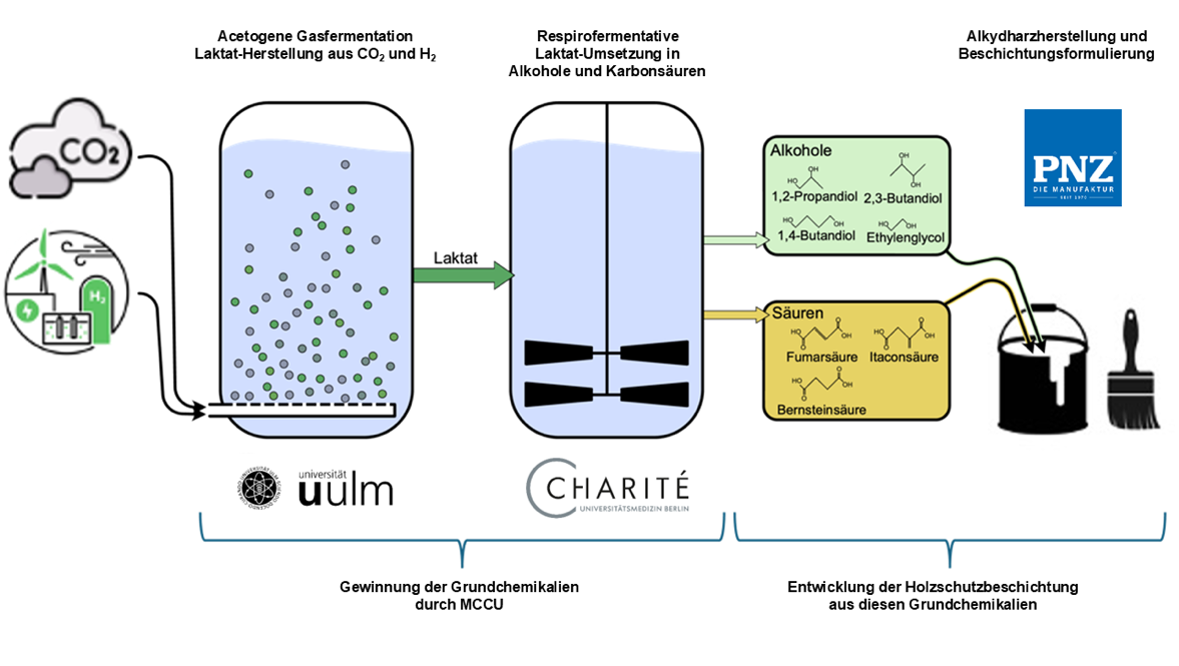
This project aims to develop an innovative process for manufacturing wood coatings in which the carbon content of the basic chemicals is directly derived from CO₂ exhaust streams. In the first step of the proposed process, CO₂ is converted into lactate by microbiological processes based on the anaerobic acetogen Acetobacterium woodii using H2 as energy source. We at UULM will genetically engineer this bacterium to enable high lactate yields. In the second process step, the lactate is converted by modified E. coli strains into alcohols and organic acids. The genetic modification of the E. coli strains, which makes bioproduction an essential part of their metabolism, is the subproject of Charité. The acids and alcohols obtained serve as starting materials for the production of bio-based alkyd resins, which are intended to be used as binders in wood preservatives. The subproject of PNZ-Produkte GmbH involves the development of a wood coating based on new reaction pathways for the esterification of the microbiologically produced basic chemicals, going beyond the current state of the art.
Our subproject: Development of genetically robust A. woodii strains for scaled lactate production from CO2 and H2
(BMWE finanziert von 2026 bis 2029)
A. woodii is an anaerobic acetogen capable of natively converting CO2 as a carbon source with H2 as an energy source into acetate via the Wood-Ljungdahl metabolic pathway in a so-called gas fermentation. In previous DFG projects, successful genetic manipulation of the metabolism of A. woodii cells established additional lactate production using the A. woodii ΔlctBCD ΔpyrE [pMTL83251_PbgaL_NFP] strain. In this A. woodii mutant, the gene of a D-lactate dehydrogenase was overexpressed and several genes of a native lactate dehydrogenase complex were deleted. The methodology for producing such genetically modified A. woodii strains is well established, and in this project, further strains with optimized metabolic performance will be constructed. Pyruvate, as a central intermediate in the metabolism of A. woodii cells, and plays a key role as it can be converted by a variety of other enzymes. Using "Design-Build-Test-Learn" (DBTL) cycles, we will identify which of these enzymes have a positive or negative influence on the production of lactate from CO2 and H2.
The composition of the medium for cultivating A. woodii must be redeveloped. Currently, it is unclear whether certain components are dosed too low and thus impair growth and production, while others, such as yeast extract, are used in excess and are problematic for industrial scale due to cost reasons. Using a "Design of Experiments" approach, the medium will be optimized to achieve optimal growth and production conditions with as few components as possible.
The results from strain and medium development will be combined to scale up gas fermentation in collaboration with the "Bio Base Europe Pilot Plant" in a pH-controlled 25-L bioreactor.
This project is funded by the Federal Ministry for Economic Affairs and Energy (BMWE) based on a decision of the German Bundestag.