


Iron levels in the body are regulated by the action of a hormonal circuit called the hepcidin-ferroportin regulatory axis. Nevertheless, over 4 billion people worldwide suffer from nutritional iron deficiency, anaemia or iron overload, including genetic haemochromatosis, which leads to organ damage, particularly to the liver, heart, joints, skin and endocrine organs. Changes in systemic and tissue iron levels, as well as iron deficiency and excess, are associated with a higher incidence and progression of metabolic syndrome and its associated complications.
Our goal is to understand the molecular mechanisms of iron homeostasis, hormonal regulation and metabolic risk and to advance the treatment of metabolic diseases.
Research focus:
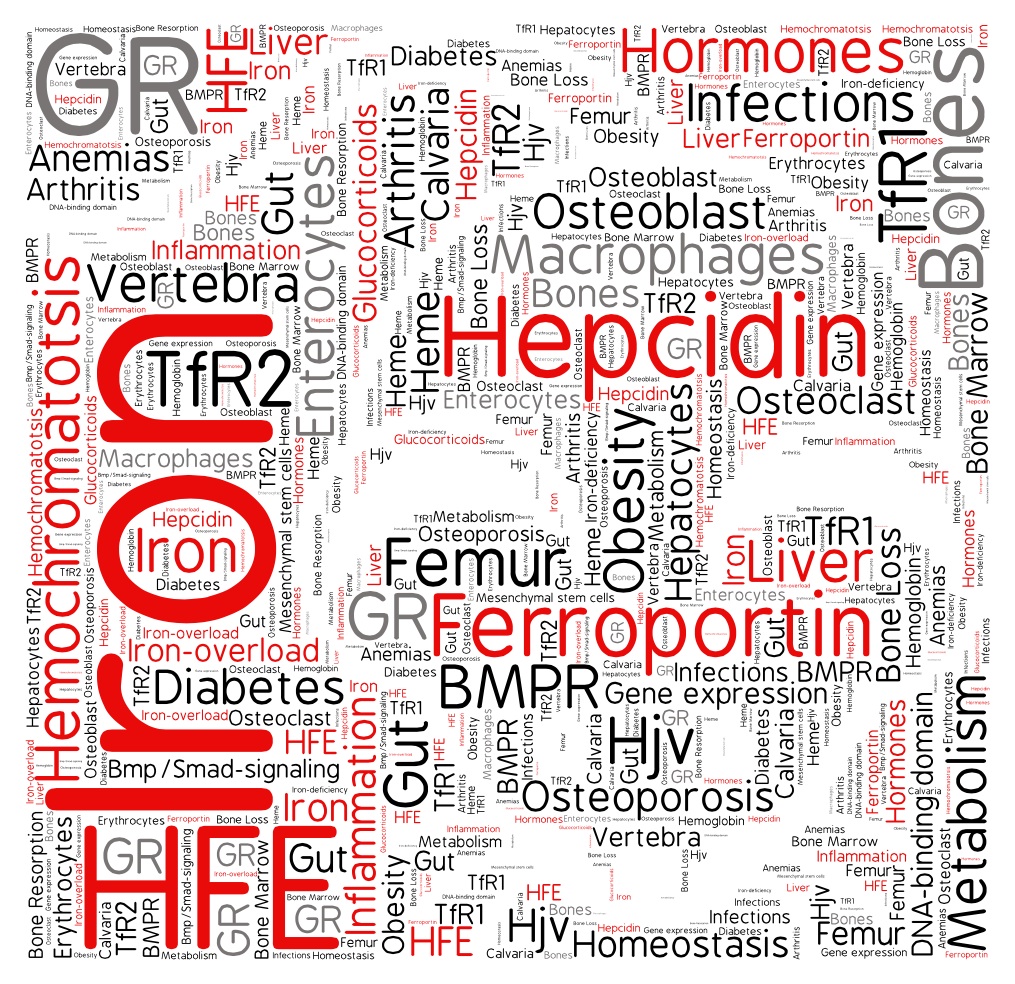
- Regulation of iron metabolism in health and disease
- Molecular understanding of genetic HFE haemochromatosis
- The role of iron/HFE in cellular metabolic pathways
- Iron-liver-bone health
- Interactions between iron and steroid hormone signalling

Publications
Comparison between dietary, parenteral, and genetic iron overload on bone health reveals secondary iron overload as a driver of cortical bone loss and fracture risk in mice.
Steele-Perkins P, Yilmaz D, Walther Y, Wagner A, Paganoni R, Rauner M, Baschant U, Vujić Spasić M. (2025) Comparison between dietary, parenteral, and genetic iron overload on bone health reveals secondary iron overload as a driver of cortical bone loss and fracture risk in mice. JBMR Plus. Jul 13;9(10):ziaf118. doi: 10.1093/jbmrpl/ziaf118. PMID: 40933230; PMCID: PMC12418933.
Iron effects versus metabolic alterations in hereditary hemochromatosis driven bone loss.
Baschant U, Altamura S, Steele-Perkins P, Muckenthaler MU, Vujić Spasić M, Hofbauer LC, Steinbicker AU, Rauner M. (2022) Iron effects versus metabolic alterations in hereditary hemochromatosis driven bone loss. Trends Endocrinol Metab. Sep;33(9):652-663. doi: 10.1016/j.tem.2022.06.004. Epub 2022 Jul 20. PMID: 35871125.
Macrophage-HFE controls iron metabolism and immune responses in aged mice.
Tangudu NK, Yilmaz D, Wörle K, Gruber A, Colucci S, Leopold K, Muckenthaler MU, Vujić Spasić M. (2021) Macrophage-HFE controls iron metabolism and immune responses in aged mice. Haematologica. Jan 1;106(1):259-263. doi: 10.3324/haematol.2019.235630. PMID: 32079697; PMCID: PMC7776264.
Scavenging Reactive Oxygen Species Production Normalises Ferroportin Expression and Ameliorates Cellular and Systemic Iron Disbalances in Hemolytic Mouse Model.
Tangudu NK, Alan B, Vinchi F, Wörle K, Lai D, Vettorazzi S, Leopold K, Vujić Spasić M. (2018) Scavenging Reactive Oxygen Species Production Normalises Ferroportin Expression and Ameliorates Cellular and Systemic Iron Disbalances in Hemolytic Mouse Model. Antioxid Redox Signal. Aug 10;29(5):484-499. doi: 10.1089/ars.2017.7089. Epub 2018 Mar 2. PMID: 29212341; PMCID: PMC6034398.
Hfe acts in hepatocytes to prevent hemochromatosis.
Vujić Spasić M, Kiss J, Herrmann T, Galy B, Martinache S, Stolte J, Gröne HJ, Stremmel W, Hentze MW, Muckenthaler MU. (2008) Hfe acts in hepatocytes to prevent hemochromatosis. Cell Metab. Feb;7(2):173-8. doi: 10.1016/j.cmet.2007.11.014. PMID: 18249176.

