



Molecular Structure Analysis: Single-Crystal X-ray Diffraction
Single-crystal X-ray diffraction is a powerful method in chemistry and materials science that makes it possible to determine the three-dimensional structure of molecules in crystals. In a typical experiment, a monocrystalline specimen is irradiated using an X-ray source and the resulting diffraction pattern can be analyzed to determine structural parameters such as atomic positions, and interatomic distances and angles.
We offer diffraction measurements for a variety of crystalline samples and are particularly well equipped to measure diffraction patterns from weakly-diffracting crystals. More Information regarding our instrumentation and service below.
Other tools to consider: NMR Spectroscopy, Mass Spectrometry and CHNS Determination
Instruments
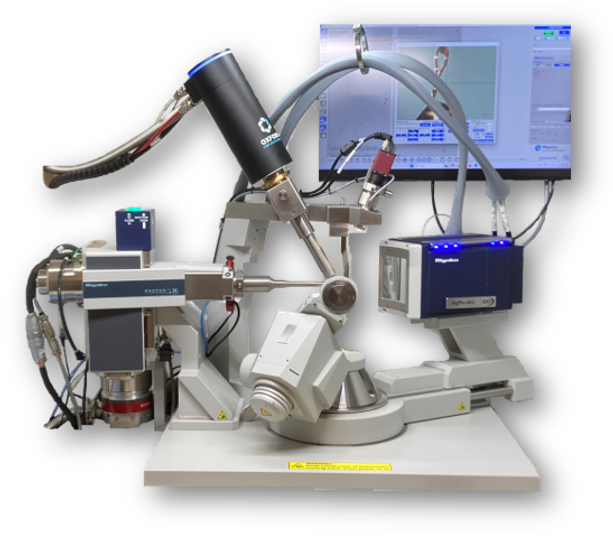
Rigaku Synergy-R (N25/1207)
X-ray Sources
- Cu Rotating Anode
Detection
- Hypix Arc 100°
Measurement Temperature Range
- 80 to 400 K
- Small Crystals, Needles
- Poorly diffracting Crystals
- Inorganic und metal-organic complexes
- Organic molecules (small to medium size)
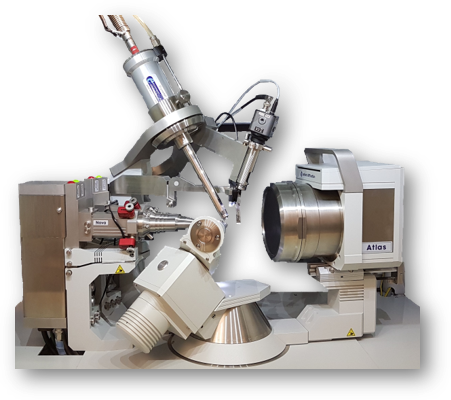
Rigaku/Oxford SuperNova (N25/1207)
X-ray Sources
- Mo and Cu microfocus sealed X-ray tubes
Detection
- Atlas Charged-Coupled Device (CCD) Detector
- Active Area (circular): 135 mm diameter
Sample Temperature Range
- r.t. to -150 °C
- Inorganic und metal-organic complexes
- Organic molecules (small to medium size)
Contact Person
Lionel Kroner, Dipl. Chem.
- +49 731 50-27429
- lionel.kroner(at)uni-ulm.de
Instrument Status
Synergy R: functioning normally
SuperNova: functioning normally
News and Updates
04.09.2026
The instrument is fully functional. Please submit samples!
25.08.2026
The repair appointment is scheduled for 3rd and 4th September. There will be no service measurements until further notice.