Elucidating structure-property relationship of high spin states in chromophore-radical dyads

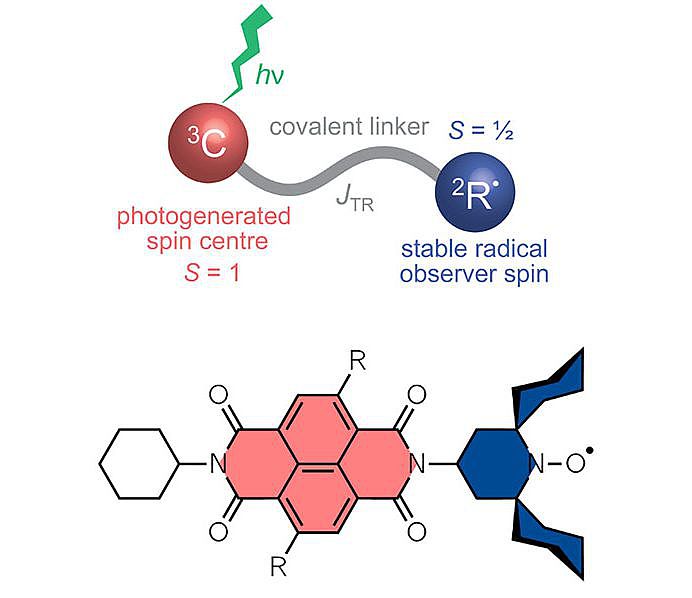
Molecular assemblies consisting of a chromophore, a linker and a stable radical may form multi-spin systems upon photoexcitation. Because of their modular nature, these molecules provide a versatile model platform to investigate structural influences on spin spin interaction and the properties of high spin states. To elucidate the photophysics and the role of electron transfer for high spin state generation, we investigate a series of core-functionalised naphthalene diimides (NDIs), that are covalently linked to a stable nitroxide radical, by optical ultrafast techniques and transient EPR spectroscopy. Beyond the scope of covalently bound chromophore-radical dyads, we investigate non-covalently bound chromophore-radical systems, including hydrogen-bonded and bimolecular assemblies.

References:
Quintes, T.; Mayländer, M.; Richert, S. Properties and applications of photoexcited chromophore-radical systems. Nat. Rev. Chem. 2023, 7, 75-90.
Khariushin, I.; Thielert, P.; Zöllner, E.; Mayländer, M.; Quintes, T.; Richert, S.; Vargas Jentzsch, A. Supramolecular dyads as photogenerated qubit candidates. Nat. Chem. 2025, 17, 493-499.
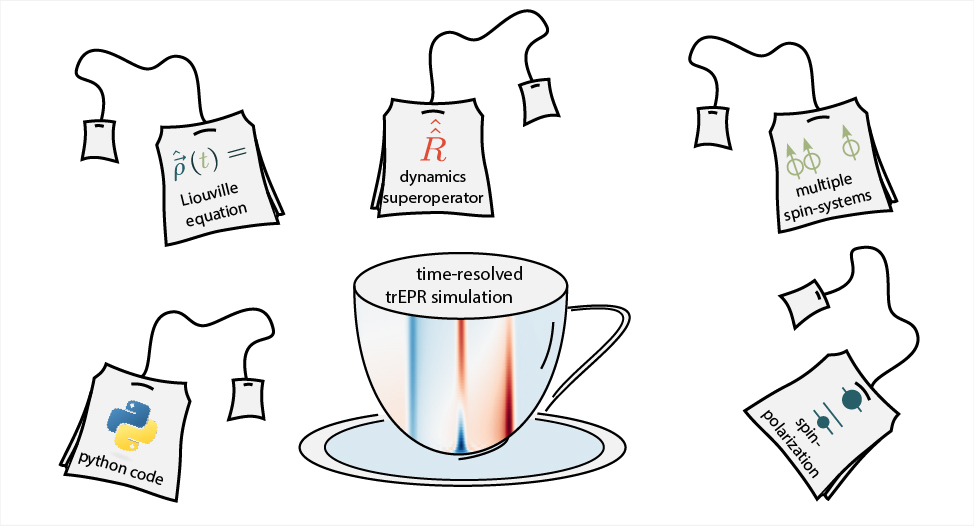
Software development for simulation of time-resolved EPR spectra

From transient EPR (trEPR) spectra, valuable information about the magnetic parameters as well as about the time evolution of the spin-polarisation can be obtained. Therefore, the Python simulation routine teacups is developed to perform corresponding analyses for triplet–doublet pairs, as well as for spin-polarised doublets, triplets, and spin-correlated radical pairs. It enables trEPR spectra to be calculated on the basis of the density matrix formalism and the stochastic Liouville equation. Furthermore, the spectra can be correlated with the time-evolution of the populations of the eigenstates. A modular setup makes the package extensible for future applications.

Reference: Quintes, T.; Weber, S.; Richert, S. Teacups, a python package for the simulation of time-resolved EPR spectra of spin-polarized multi-spin systems. J. Phys. Chem. A 2025, 129, 3375–3388

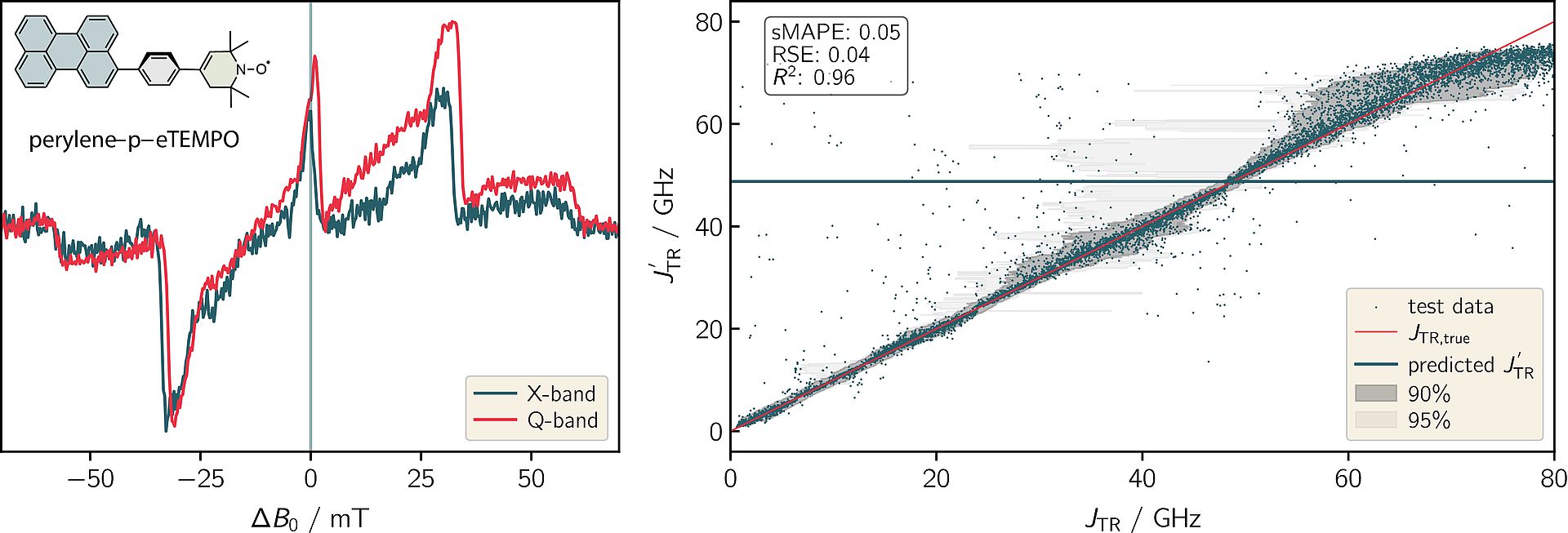
A neural network for the prediction of the exchange coupling

The exchange coupling of triplet–doublet pairs (TDPs) is experimentally difficult to access but is crucial for the characterization of photoexcited chromophore–radical systems. The net polarization of the quartet spectra of TDPs depends on both the external magnetic field and the exchange coupling JTR. In order to predict the value of JTR from a set of three spectra measured in different EPR bands, a neural network is trained.

Photochemical spin state switches 

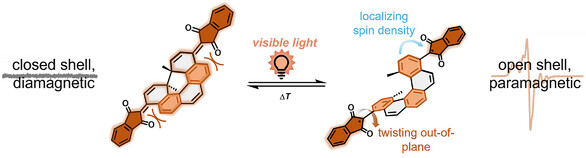
In a collaborative project with the Dumele lab, we investigate photochemical spin state switches that undergo light-induced reversible switching between a diamagnetic and a paramagnetic state. Our contribution focuses on the magnetic characterization of the samples and on supporting the elucidation of the underlying switching mechanism. 

Reference: Schlecht, J.; Lohmiller, T.; Thielert, P.; Doublas, C.; Gather, M.; Richert, S.; Dumele, O. Photochemical spin-switching of an all-organic molecular system with visible light. Angew. Chem. Int. Edit. 2025, 64, e202515144.

New sensitisers for triplet-triplet annihilation 

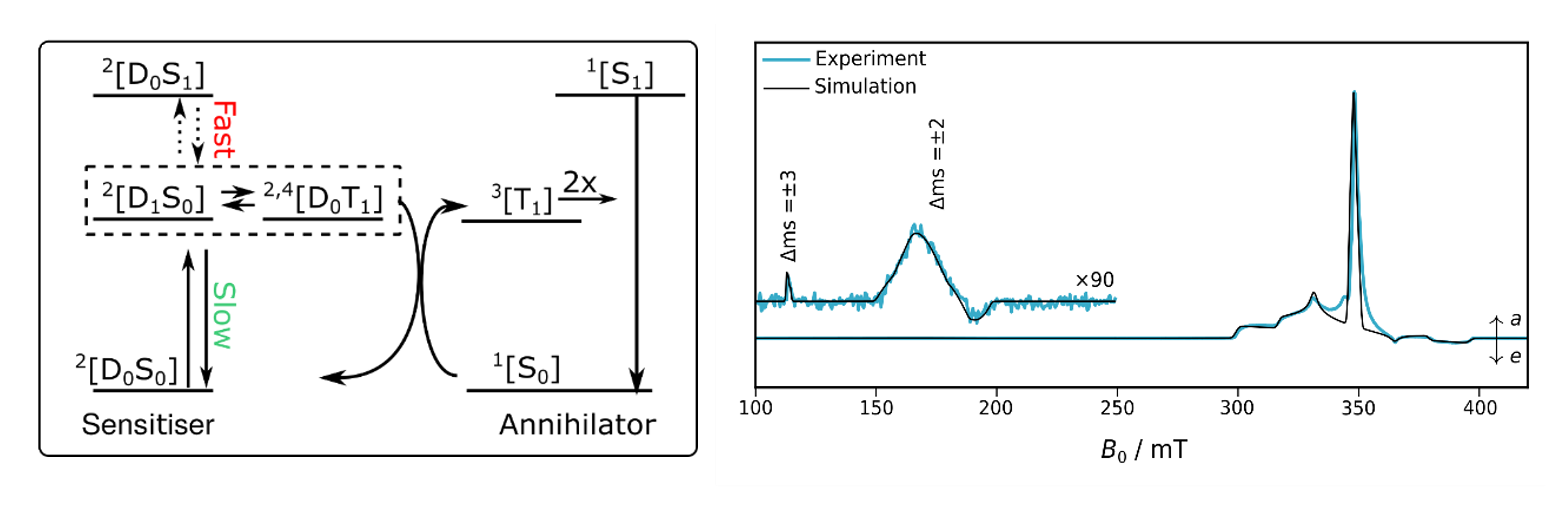
As part of a collaborative effort, we investigate open-shell sensitisers for triplet-triplet annihilation (TTA), with a focus on characterising their excited spin state properties. These insights contribute to the rational optimization of sensitisers for TTA applications.