
Contact
Enquiries regarding layout and design, as well as requests for the design of materials:


The Ulm University was founded in 1967 as a higher education institution for medicine and natural sciences. Since then, it has been equally committed to research and teaching as it is to society. Its founding disciplines and values are reflected in its logo. The graphic elements – the ‘ellipses’ and the ‘Rod of Asclepius’ – symbolise the university’s original subjects.
The terms ‘Sciendo, Docendo, Curando’ stand for research within the meaning of creating knowledge, for teaching within the meaning of imparting knowledge, and for healing within the meaning of applying knowledge.
The typography and colour scheme are based on the visual identity of the city of Ulm. This reflects the close ties between the city and Ulm University.
Enquiries regarding layout and design, as well as requests for the design of materials:
Ulm University’s logo forms part of its corporate identity. It serves to ensure that Ulm University is clearly recognisable in all communications. The University’s logo always consists of the combined word and figurative mark. The composite mark may only be used in this specified arrangement and without any change to their proportions. The logo may not be distorted or rotated.
The figurative mark must not be altered or redesigned for other purposes.
The German-language logo is also used as such in an international context.
All members of the university are entitled as well as obliged to use the logo for official purposes.
Transferring the logo to third parties for purposes other than official business requires authorisation.
The Ulm University logo is used by Ulm University’s main channels and may therefore under no circumstances be used as a profile or channel image by other social media accounts.

The standard application is 100% black on light or white backgrounds. However, the saturation can be reduced to 80% (“anthracite”) for a more subtle effect.
For web applications, 100% black must always be used. The contrast ensures better accessibility.
The white-on-black version is used on dark backgrounds, e.g. when superimposed on photographs. Care must be taken to ensure a clear contrast.

The Ulm University logo is always positioned on the right-hand side within a white field. This is a distinctive feature that runs consistently across all media.
The buffer zone specifies the minimum distance from other design elements. The distance from the right-hand margin must be at least the width of the buffer zone and is aligned with the type area.

The dimensions of the logo (width) are specified for use on various DIN formats. They are already correctly positioned on the sample templates in the internal download section of the website. The logo templates are available in a width of 100 mm and can be scaled proportionally.
| DIN long (portrait/landscape) | 44 mm |
| DIN A5 portrait/landscape | 55 mm |
| DIN A4 portrait/landscape | 73 mm |
| DIN A3 portrait/landscape | 101 mm |
| DIN A2 portrait/landscape | 157 mm |
| DIN A1 portrait/landscape | 198 mm |
| DIN A0 portrait/landscape | 280 mm (smaller sizes are also permitted for scientific posters) |
The minimum width in print should not be less than 25 mm.
Exceptions for very small applications are permitted for merchandising items such as ballpoint pens, pencils and the like. The required special typographic format is available from kiz (Communication and Information Centre) by arrangement.

Ulm University has a single logo (“University logo”), which must be used in all official communication media intended for external representation. In all media, Ulm University must unmistakably be recognised as the primary sender.
Sub-logos of units affiliated with Ulm University may not be used on their own without the Ulm University logo. The connection to Ulm University as the parent organisation must always be evident. The sub-logo may not dominate the Ulm University logo in terms of size, placement or visual impact. It is recommended that sub-logos be placed separately from the Ulm University logo where space permits.
Joint projects may use their own mark, provided that Ulm University remains clearly recognisable as the institutional parent brand.
Sub-logos created before 1 March 2026 are generally protected and may continue to be used. To ensure a consistent visual identity, it is recommended that the lettering be adapted to the corporate typeface Meta.
New sub-logos may only be be created as text-based designs using the corporate typeface Meta. They must have an understated design and may not compete with the university logo. The design of new sub-logos must be coordinated with the Marketing Department and kiz medien5 .
The licence to use for sub-logos must be documented. The institution which commissioned or uses the sub-logo is responsible for documenting these licences and for ensuring compliance with any legal restrictions on its use.

Ulm University’s basic colour scheme is based on black, dark grey, light blue and white.
This is supplemented by the colours of each faculty and their respective shades.
The accent colour may be used across all faculties.

The visual identity of Ulm University is also characterised by a consistent typography.
For the production of professionally designed and printed promotional materials, the fee-based Meta font is designated as the official corporate typeface. The necessary licences for using Meta are held by kiz (Communication and Information Centre). Individual licences can be purchased from various providers.
Fira Sans is used for the University’s website. It is available licence-free and may also be used as a compromise solution for printed materials produced in-house.
If Meta and Fira are not available, the system font Arial is initiated as an alternative. The consistent use of Arial in office communications ensures a uniform visual identity and is available on all data processing systems.
In general, to ensure good legibility, it is recommended to use clearly distinguishable font weights, a limited number of different font sizes within a single document, and left-justified justified text. Additional effects reduce legibility and are not in keeping with the desired clear and uncluttered visual identity.

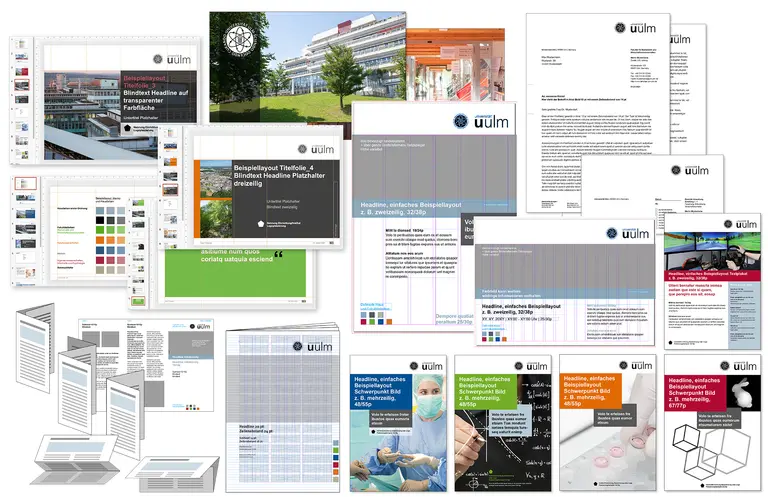
A wide range of standard templates is available in the internal download area (accessible only via the university network). They contain only a few design elements, such as the logo, a type area and defined colours. In PowerPoint, master slides have been created and applied as examples to standard pages. Business cards are produced and printed to order at kiz (Communication and Information Centre).
University business cards are produced at the kiz (Communication and Information Centre) to order in line with the corporate design and printed externally.
The Design Service at the kiz | Media Department will be happy to assist you with your design requirements and will handle the external printing process on your behalf.
Please note that the kiz does not handle external printing for files created by customers themselves.
The only items that can still be printed in-house at the kiz are posters.
The general design guidelines also apply to this area.
If you require any design work at present, please contact the Service Design team at kiz | Dept. of Media.
Roll-ups cannot be produced in-house at the university.

The design of the University’s websites should be based on the corporate design and the main websites of Ulm University, and should summarise relevant information at a glance. Texts should be concise and understandable, and supported visually by photographs.
For official purposes, only Ulm University websites hosted within the www.uni-ulm.de domain may be used. Joint projects with external partners are exempted from this rule.

The visual style is based on the brand’s core attributes. The focus is on people who are natural and behave authentically. Particular attention should be paid to creating visually dynamic compositions, a clear focus and fresh colours.
Wherever possible, photographs provided by the University should be used. Visual material is protected by Copyright; photographs provided by the University may be used for official purposes. In all cases, licence conditions must be observed and rights of use clarified. Otherwise, the use of photographs, images or graphics from third parties should be avoided.
To place an order, please contact the Photography Service at kiz | Dept. of Media. Models, props and locations (subject to agreement) must be organised by the client.
The use of AI-generated photographic representations of real people or situations in the Ulm University’s public image does not comply with the University of Ulm’s commitment to truthfulness. Photo adjustments using AI tools within the meaning of photo retouching (e.g. removal of distracting objects), which do not alter the message conveyed by the image, are permitted. Collages and montages of authentic photographs are permitted.
Graphics or illustrations may be created using AI tools, but must be clearly recognisable as illustrative, and labelled as AI generated. However, they do not fit with Ulm University’s visual language and should therefore only ever be used in a supporting role.

A filming permit is required for films and videos shot on the Ulm University campus for public relations purposes. For safety reasons (including emergency flights to the Ulm University Hospital and the Bundeswehrkrankenhaus BWK (military hospital)), drone footage is generally not permitted.
Films and videos should be consistent with the corporate design in terms of style and tone. Here too, the Ulm University logo must be incorporated in a suitable position.
