


Trophic Health: Effects of fertilization on AMR and zoonotic pathogen accumulation along the trophic chain – towards a One Health perspective in circular agriculture
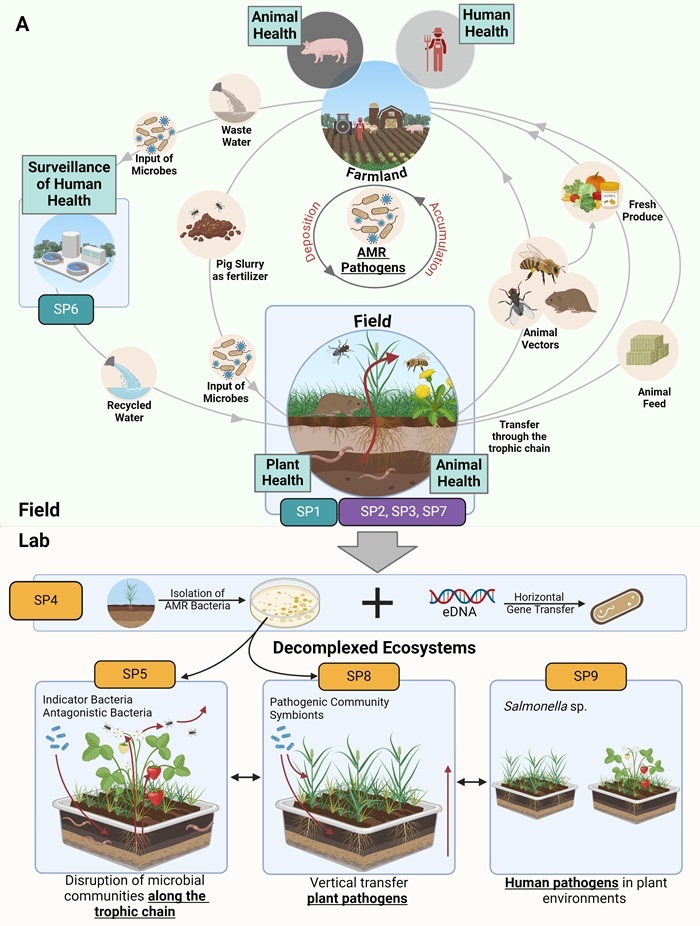
We aim to study how circular agriculture can spread AMR and zoonotic pathogens from livestock to the environment and back, and how ecosystem resilience may interrupt this cycle that threatens the health of humans, animals, plants, and our environment. We will combine a pan-microbiome approach with metagenomics in order to identify pathogens, AMR as well as antimicrobial peptide producers, which may in turn stabilize microbial ecosystems preventing the spread of harmful microbes. To address this detrimental cycle inherent to circular agriculture, we will survey microbial communities from soil, wastewater, plants and potential animal vectors, and experimentally verify the potential spread and mitigation of AMR and pathogens in a series of de-complexed mesocosm experiments. TrophicHealth will refine AMR and pathogen surveillance on our doorstep and in immediate food chain, as well as identify potential mitigation strategies significantly contributing to OneHealth by blocking the cycling of harmful microbes. This work will improve surveillance by the RKI and the Umweltbundesamt, and support veterinarian and farmers in their efforts to transition to sustainable and safe livestock farming.
Funded by the BMFTR (Globale Gesundheit: Forschungsverbünde zum Thema „Pandemieprävention und -reaktion im Rahmen eines One-Health-Ansatzes“ (Principal Investigator, PI: Prof. Dr. Simone Sommer)
https://www.gesundheitsforschung-bmftr.de/de/forschungsverbunde-zum-thema-pandemiepravention-und-reaktion-im-rahmen-eines-one-health-19057.php
TrophicHealth - Auswirkungen von Düngung auf die Akkumulation von AMR und Zoonoseerregern entlang der Nahrungskette - auf dem Weg zu einer One-Health-Perspektive in der zirkulären Landwirtschaft - Gesundheitsforschung BMFTR
https://www.gesundheitsforschung-bmftr.de/de/trophichealth-auswirkungen-von-dungung-auf-die-akkumulation-von-amr-und-zoonoseerregern-19403.php
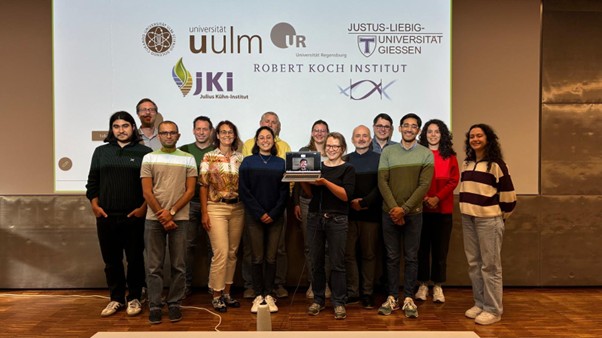
Kick-off Meeting TrophicHealth, 21./22. Apil 2026, Ulm. Consortia members are from Ulm University, University of Regensburg, Justus Liebig University Giessen, Robert-Koch Institute (RKI) Berlin, and Julius Kühn Institute (JKI) Braunschweig. PI Prof. Dr. Simone Sommer (Ulm University).
Beteiligte WissenschaftlerInnen
Prof. Dr. Simone Sommer (PI, Koordination, TP2, TP7) Institut für Evolutionsökologie und Naturschutzgenomik, Universität Ulm
Prof. Dr. Lena Wilfert (TP1, TP5), Universität Regensburg
Prof. Dr. Bork Berghoff (TP4), Institut für Molekularbiologie und Biotechnologie der Prokaryoten, Universität Ulm
Prof. Dr. Christian Riedel (TP4), Institut für Evolutionsökologie und Naturschutzgenomik, Universität Ulm
Prof. Dr. Patrick Schäfer (TP8), Institut für Phytopathologie, Justus-Liebig-Universität Giessen
Dr. Stephan Fuchs (TP3, TP6), Genome Competence Centre, Robert-Koch-Institut Berlin
Dr. Sofia Paraskevopoulou (TP6), Viroinformatics, Robert-Koch-Institut Berlin
Prof. Dr. Adam Schikora (TP9), Institute for Epidemiology and Pathogen Diagnostics, Julius-Kühn-Institut Braunschweig
Gefördert durch das Bundesministerium für Forschung, Technik und Raumfahrt (BMFTR) „Globale Gesundheit: „Pandemieprävention und -reaktion im Rahmen eines One-Health-Ansatzes“, Projektträger DLR