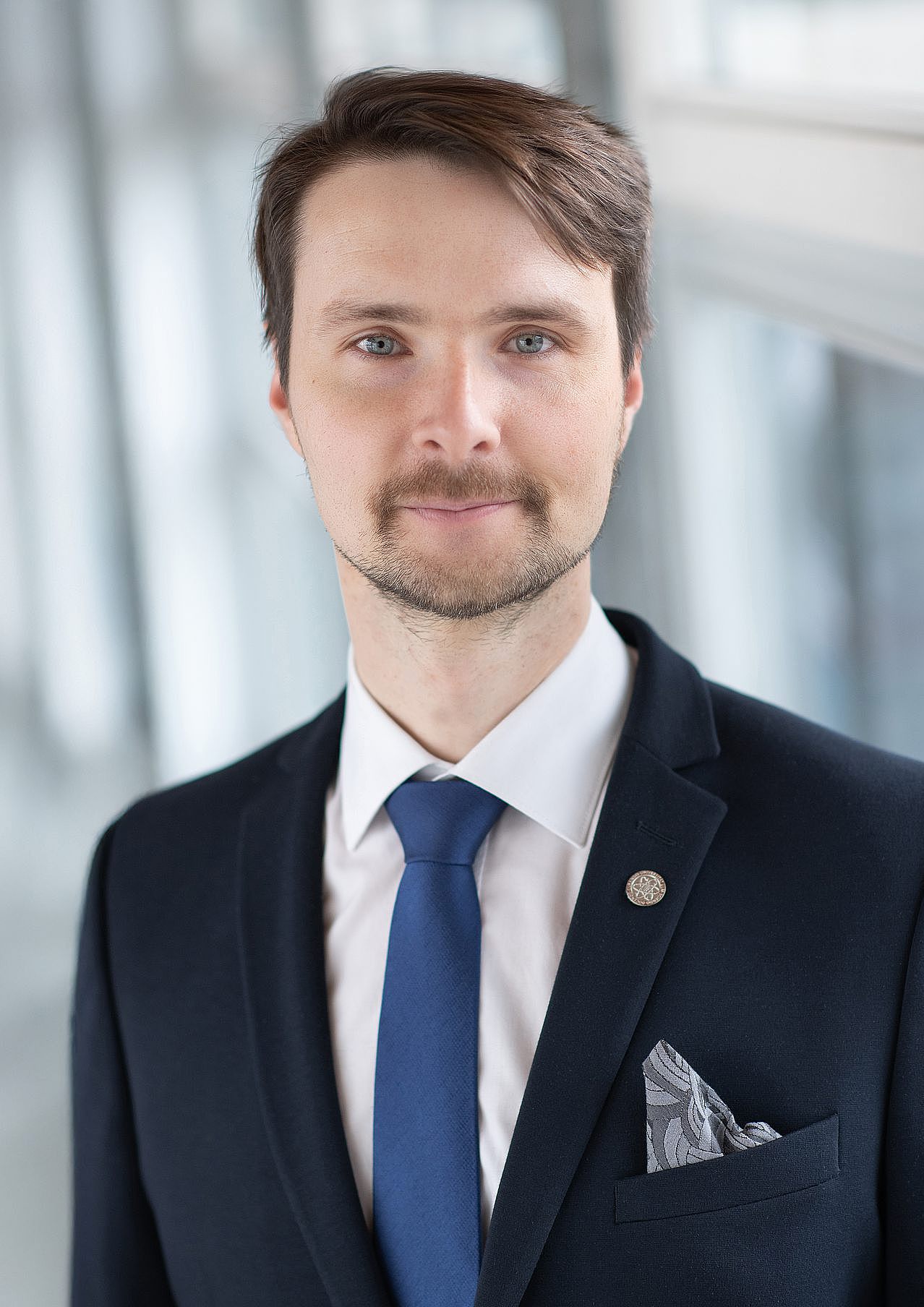
Prof. Dr. Fabian Just

Fabian Just
Prof. Dr. Fabian Just
Stellv. Institutsdirektor
Institut für Biomedizinische Technik
Universität Ulm
Albert-Einstein-Allee 45
89081 Ulm
Deutschland
Raum: 45.2.228

Prof. Fabian Just

is Professor (W3) for Mental Health Technologies at Ulm University since October 2025. He is Deputy Director of the Institute of Biomedical Engineering in the Faculty of Engineering, Computer Science and Psychology. His work focuses on holistic rehabilitation, merging physical restoration with cognitive and emotional well-being through intelligent assistive and robotic rehabilitation technologies.

Before joining Ulm University, Prof. Just conducted research at Chalmers University of Technology in Gothenburg, Sweden, where he led the Arm Robotics Group at the Center of Bionics and Pain Research and the Orthopedical Exoskeleton Group at Chalmers Industriteknik. His groups there pioneered advanced upper and lower limb exoskeletons and prosthetic control systems, achieving some of the world’s first single-finger myoelectric control for prosthetic hands.

He holds a Ph.D. from ETH Zürich in Biomedical Engineering and Control , where he built and developed the latest generation of the ARMin exoskeleton, focusing on intelligent, user-intuitive, sensor-based adaptive control for both patient and therapist.  He also holds a Master’s degree in Electrical and Computer Science from Purdue University (USA) and in Control Engineering  from Ruhr University Bochum (Germany). He received first-place paper and presentation awards at several international conferences and was a scholar and student group leader of the Foundation of German Business (Stiftung der Deutschen Wirtschaft) as well as a DAAD scholarship recipient.

Prof. Just’s current research explores wearable and robotic technologies that sense, interpret, and dynamically adapt to human movement and performance. In his upcoming work at Ulm University, he aims to extend these concepts toward mental health technologies, developing systems that also respond to cognitive and emotional states. His long-term goal is to enable holistic rehabilitation, combining physical recovery with mental resilience, motivation, and quality of life.  

Research Goals and Interests

Prof. Just’s research integrates control engineering, human–machine interaction, and biomedical technology. His key areas of interest include:

  • Holistic rehabilitation and the fusion of mental and physical health
  • Adaptive control and machine learning for assistive robotics
  • Multimodal sensing and real-time feedback in prosthetics and exoskeletons
  • Support of Decision-making of Therapists and medical personal
  • Wearable systems for orthopedic- and neurorehabilitation 

Externer Inhalt

Um diesen Inhalt zu verwenden (Quelle: www.xyz.de ), klicken Sie bitte auf Akzeptieren. Wir möchten Sie darauf hinweisen, dass durch die Annahme dieser IFrames Daten an Dritte übertragen oder Cookies gespeichert werden könnten.

Weitere Informationen finden Sie in unserer Datenschutzerklärung.


Externer Inhalt

Um diesen Inhalt zu verwenden (Quelle: www.xyz.de ), klicken Sie bitte auf Akzeptieren. Wir möchten Sie darauf hinweisen, dass durch die Annahme dieser IFrames Daten an Dritte übertragen oder Cookies gespeichert werden könnten.

Weitere Informationen finden Sie in unserer Datenschutzerklärung.


Externer Inhalt

Um diesen Inhalt zu verwenden (Quelle: www.xyz.de ), klicken Sie bitte auf Akzeptieren. Wir möchten Sie darauf hinweisen, dass durch die Annahme dieser IFrames Daten an Dritte übertragen oder Cookies gespeichert werden könnten.

Weitere Informationen finden Sie in unserer Datenschutzerklärung.

Publikationen

Ausgewählte Publikationen. Eine vollständige Liste finden Sie auf unserer Forschungsseite.

Vianello L, Short M, Manczurowsky J, Küçüktabak EB, Tommaso FD, Noccaro A, Bandini L, Clark S, Fiorenza A, Lunardini F, Canton A, Gandolla M, Pedrocchi ALG, Ambrosini E, Murie-Fernández M, Román CB, Tornero J, Leon N, Sawers A, Patton J, Formica D, Tagliamonte NL, Rauter G, Baur K, Just F, Hasson CJ, Novak VD, Pons JL. Robot-Mediated Physical Human–Human Interaction in Rehabilitation: A Position Paper. IEEE Reviews in Biomedical Engineering. 2025; 1—16.      [DOI]      [Datei] 
Al-Tashi M, Lennartson B, Ortiz-Catalan M, Just F. Classroom-ready open-source educational exoskeleton for biomedical and control engineering. at - Automatisierungstechnik. 2024 Mai; 72(5):460—475.      [DOI]      [Datei] 
Earley EJ, Zbinden J, Munoz-Novoa M, Just F, Vasan C, Holtz AS, Emadeldin M, Kolankowska J, Davidsson B, Thesleff A, Millenaar J, Jönsson S, Cipriani C, Granberg H, Sassu P, Brånemark R, Ortiz-Catalan M. Cutting Edge Bionics in Highly Impaired Individuals: A Case of Challenges and Opportunities. IEEE Transactions on Neural Systems and Rehabilitation Engineering. 2024; 321013—1022.      [DOI]      [Datei] 
Just F, Ghinami C, Zbinden J, Ortiz-Catalan M. Deployment of Machine Learning Algorithms on Resource-Constrained Hardware Platforms for Prosthetics. IEEE Access. 2024; 1240439—40449.      [DOI]      [Datei] 
Just F, Özen Ö, Tortora S, Klamroth-Marganska V, Riener R, Rauter G. Human arm weight compensation in rehabilitation robotics: efficacy of three distinct methods. Journal of NeuroEngineering and Rehabilitation. 2020 Dez.; 17(1):13.      [DOI]      [Datei] 
Just F, Özen Ö, Bösch P, Bobrovsky H, Klamroth-Marganska V, Riener R, Rauter G. Exoskeleton transparency: feed-forward compensation vs. disturbance observer. at - Automatisierungstechnik. 2018 Dez.; 66(12):1014—1026.      [DOI]      [Datei] 
BibTeX downloadXML download