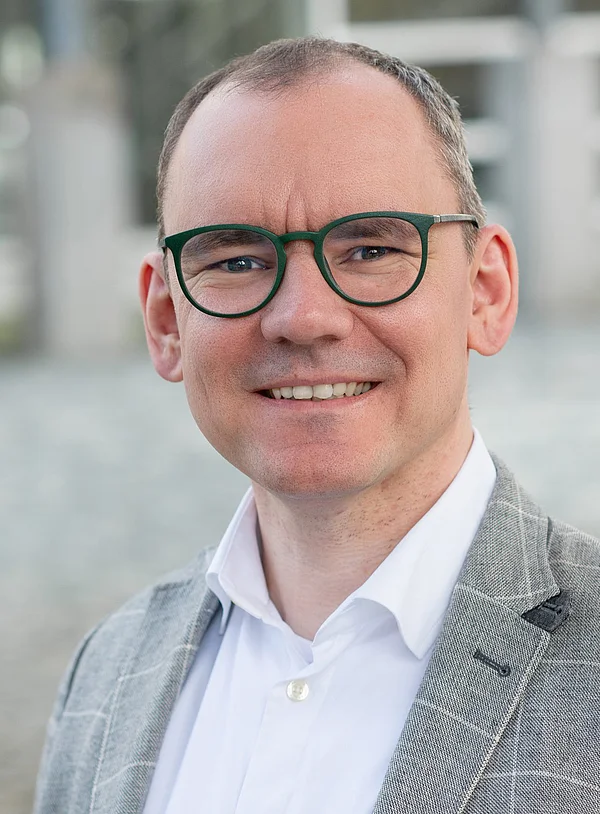
Steffen Wendzel is the Chair of the Institute of Information Resource Management (IRM / OMI) and Director of the kiz (university library and computing center). He received his habilitation (2020) and PhD (Dr. rer. nat., 2013) from the University of Hagen, Germany. Before joining Ulm University, he was a lecturer (Privatdoz.) at the Faculty of Mathematics and Computer Science, FernUniversität in Hagen, a professor and director of the Center for Technology and Transfer (ZTT), Hochschule Worms, and a PostDoc at the Dep. Cyber Security, Fraunhofer FKIE, Bonn.

Current Roles:

  • since 2024: Chair of the Institute of Information Resource Management (OMI)
  • since 2024: Director of the Library and Computing Center (kiz), Ulm University
  • since 2026: Scientific Spokesperson of BelWü
  • since 2024: Member: Working Group of the Scientific Computing Center Directors Baden-Württemberg (ALWR)
  • since 2024: Member: Working Group of the Library Directors Baden-Württemberg (AG BibDir)
  • since 2025: Responsible for the State-level High-performance Computing Project bwHPC-S5 (jointly with Prof. M. Frank, KIT)
  • since 2025: Member: consultative group for bwInfoSec
  • since 2024: Member: Senatsausschuss Lehre, Universität Ulm
  • since 2024: Member: Lenkungsausschuss des Projekts Campusportal zur Einführung von HISinOne, Ulm University
  • since 2025: DFN Representative for Ulm University
  • since 2025: ZKI Representative for Ulm University
  • since 2026: External member RARP (Rechenzentrumsallianz Rheinland-Pfalz)

More information: https://www.wendzel.de/

Publikationen

64.
Keller J, Spenger G, Wendzel S. Ant colony-inspired parallel algorithm to improve cryptographic pseudo random number generators. In: 2017 IEEE Security and Privacy Workshops (SPW 2017). 2017 p. 17—22.      [DOI]      [Datei] 
63.
Wendzel S, Mazurczyk W, Haas G. Don’t you touch my nuts: Information hiding in cyber physical systems. In: 2017 IEEE Security and Privacy Workshops (SPW 2017). 2017 p. 29—34.      [DOI]      [Datei] 
62.
Kobekova A, Bültermann L, Tonejc J, Wendzel S. Was bedeutet das IT-Sicherheitsgesetz für Smart Buildings? Konzepte des sicheren Alterns der Gebäude-IT. In: Tagungsband des 15. Deutschen IT-Sicherheitskongresses des BSI. SecuMedia Verlags-GmbH; 2017 p. 515—526.     [Datei] 
61.
Wendzel S, Mazurczyk W, Zander S. A Unified Description Method for Network Information Hiding Methods. Journal of Universal Computer Science (J.UCS). 2016; 22(11):1456—1486.      [DOI]      [Datei] 
60.
Kaur J, Wendzel S, Eissa O, Tonejc J, Meier M. Covert channel-internal control protocols: attacks and defense. Security and Communication Networks (SCN). 2016; 9(15):2986—2997.      [DOI]      [Datei] 
59.
Wendzel S. How to Increase the Security of Smart Buildings. Communications of the ACM (CACM). 2016; 59(5):47–49.      [DOI]      [Datei] 
58.
Wendzel S, Kasem-Madani S. IoT Security: The Improvement-Decelerating 'Cycle of Blame'. Journal of Cyber Security and Mobility (JCSM). 2016      [DOI]      [Datei] 
57.
Naumann M, Wendzel S, Mazurczyk W, Keller J. Micro protocol engineering for unstructured carriers: on the embedding of steganographic control protocols into audio transmissions. Security and Communication Networks (SCN). 2016; 9(15):2972—2985.      [DOI]      [Datei] 
56.
Mazurczyk W, Wendzel S, Azagra Villares I, Szczypiorski K. On importance of steganographic cost for network steganography. Security and Communication Networks (SCN). 2016; 9(8):781—790.      [DOI]      [Datei] 
55.
Wendzel S, Keller J. Special Issue on Security, Privacy and Reliability of Smart Buildings. Journal of Universal Computer Science (J.UCS). 2016; 22(9):1201—1202.      [DOI]      [Datei] 

Offene Abschlussarbeiten und Projekte

4.
(AI-based) Intrusion Detection for Supercomputing . 2026
3.
Covert Channel Amplification (Multiple Topics Available) [Bachelor/Master]. 2026
2.
Fuzzing for Censorship Circumvention [Bachelor/Master]. 2025
1.
Evaluation of Tor Obfuscation Extensions [Bachelor/Master]. 2024