


Digitale Plattformen & Märkte
Overview and learning objectives
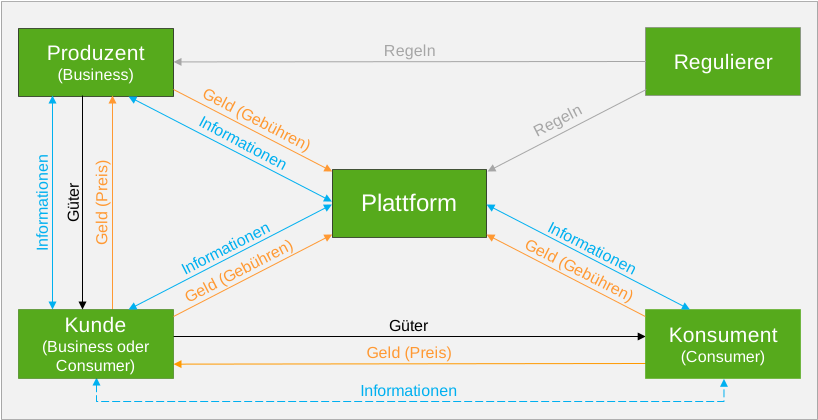
Digital platforms are a ubiquitous phenomenon that transforms traditional one-sided markets (traditional value creation) into multi-sided markets, which in turn leads to fundamental changes in the flow of goods, information and money in (digital) markets. It is important to understand these fundamental changes and the underlying mechanisms in order to make a successful career in companies that operate in digital markets.
Lecturers


Course information
The course “Digitale Plattformen & Märkte” explains the basic mechanisms of digital platforms and markets and their economic impact on market participants. You will learn about the fundamental differences between digital and physical goods and gain a comprehensive understanding of pricing models (cash flows) and information asymmetries (information flows) in digital markets. You will understand how network effects work and how digital platforms can be successfully designed with the help of customer review systems, digital nudging, gamification, and digital marketing. In addition, you will learn how the market power of digital platforms can be limited and what potential blockchain technology has for disrupting digital platforms.
This module covers the following technical content:
- Introduction and fundamentals of digital markets
- Distinction between digital and physical goods
- Information asymmetries in digital markets
- Introduction and fundamentals of digital platforms
- Digital platforms and network effects
- Design of digital platforms
- Customer reviews
- Pricing models in digital markets
- Influencing consumer behavior in digital markets through gamification and nudging
- Digital marketing
- Regulation of digital markets
- Blockchain as a disruptive marketplace
- Thaler, Richard H.; Sunstein, Cass R.; Bausum, Christoph (2018): Nudge. Wie man kluge Entscheidungen anstößt. Ungekürzte Ausgabe im Ullstein Taschenbuch, 13. Auflage. Berlin: Ullstein (Ullstein, 37366).
- Choudary, Sangeet Paul; Parker, Geoffrey; van Alstyne, Marshall (2017): Die Plattform-Revolution: Von Airbnb, Uber, PayPal und Co. lernen: Wie neue Plattform-Geschäftsmodelle die Wirtschaft verändern. Place of publication not identified, s.l.: MITP Verlags GmbH & Co. KG.
- Chou, Yu-Kai (2016): Actionable gamification. Beyond points, badges, and leaderboards. Fremont, CA: Octalysis Media.
- Evans, David S.; Schmalensee, Richard (2016): Matchmakers. The new economics of multisided platforms. Boston, Massachusetts: Harvard Business Review Press.
- Easley, David; Kleinberg, Jon (2010): Networks, crowds and markets. Reasoning about a highly connected world. Cambridge: Cambridge Univ. Press
Organizational information
Next course start: WiSe 26/27
Place: tbd
Term: tbd
Block seminar: tbd
Start of lecture: tbd
Lecture (2 SWS) with Exercise (2 SWS)
Credit points are awarded on the basis of passing the written module examination.
The module grade corresponds to the result of the module examination.
Focus: Business Analytics, Technologie- und Prozessmanagement, Wahlpflicht BWL, Wahlpflicht VWL and focus Economics
Programs: M.Sc. Wirtschaftswissenschaften, M.Sc. Wirtschaftsinformatik - Digital Business und Analytics, M.Sc. Wirtschaftsmathematik, M.Sc. Wirtschaftschemie, M.Sc. Wirtschaftsphysik und Studiengänge mit Nebenfach Wirtschaftswissenschaften