


Welcome to the laboratory of Bork Berghoff
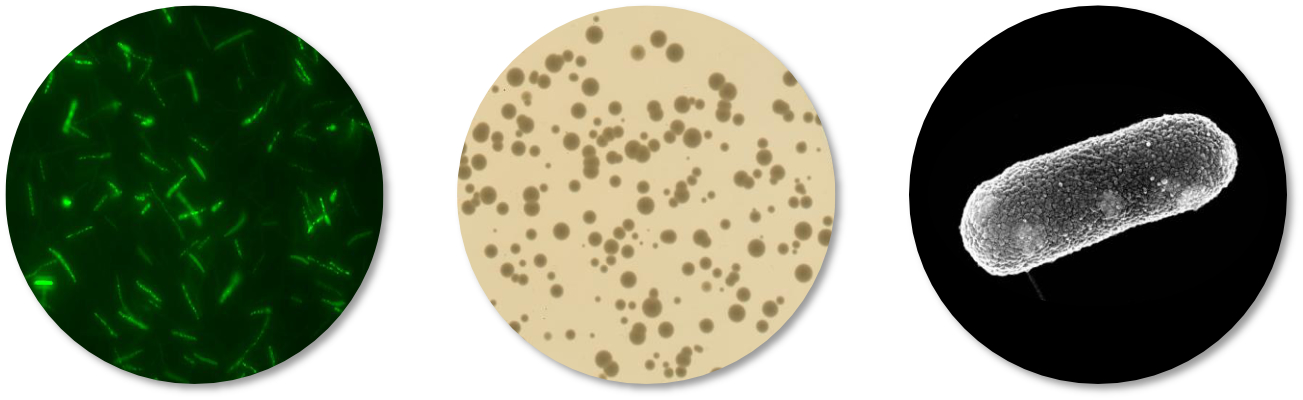
We are interested in toxin-antitoxin systems, antibiotics, RNA biology and stress resilience in bacteria.
Lab members
Publications
We are working on the following projects:
Toxin-antitoxin systems and small membrane toxins
Toxin-antitoxin systems are widespread in the prokaryotic world. Although they were originally discovered on plasmids, they are also found on chromosomes, sometimes in astonishingly high numbers. Plasmid-encoded toxin-antitoxin systems primarily facilitate plasmid maintenance in growing populations. However, their chromosomal counterparts are less well understood. Their potential functions include genetic stabilization, defense against phages and responses to stress. For instance, the type I toxin-antitoxin system tisB/istR-1 from Escherichia coli belongs to the SOS response to DNA damage. TisB is a small membrane toxin that causes depolarization of the inner membrane, ATP depletion and other secondary effects that collectively support bacterial dormancy and antibiotic tolerance. We are interested in the functionality of these small membrane toxins and their impact on the physiology of bacterial cells.
The probiotic Escherichia coli strain Nissle 1917
Escherichia coli strain Nissle 1917 is a probiotic bacterium that has been used to treat intestinal disorders for more than a century. It is well known for its ability to antagonize pathogenic enterobacteria, and its competitive success is partly founded in the production of antagonistic active substances, such as microcins and colibactin. We are interested in several aspects of the lifestyle of this fascinating bacterium, including plasmid-derived toxin-antitoxin systems and gene regulation by small RNAs under competitive growth conditions. Furthermore, E. coli Nissle is studied as a model system for bacterial dormancy after long-term storage in nutrient-deprived environments.
Dissemination of antibiotic resistance genes in agricultural ecosystems
Disturbance of ecosystems poses a threat to the health of animals, plants and humans. Extensive agriculture and usage of fertilizers may interfere with a natural and healthy microbiome composition along the whole trophic chain. This might be partly attributable to the misuse of antibiotics and the contamination of natural habitats with antibiotics from anthropogenic sources. The combination of ecosystem disturbance and antibiotic exposure gives rise to the spread of antimicrobial resistant (AMR) bacteria, including potential nosocomial and zoonotic pathogens. We are interested in the prevalence of AMR pathogens in agricultural ecosystems and the dissemination of antibiotic resistance genes via horizontal gene transfer.
The dissemination of antibiotic resistance genes is studied in the framework of the TrophicHealth consortium, which is funded by BMFTR.
Synthetic small RNAs as tools for gene regulation
Small RNAs are versatile regulators in prokaryotes. In many cases, small RNAs consist of distinct functional modules, such as seed regions, binding sites for RNA-binding proteins and Rho-independent terminator hairpins. Synthetic biology approaches are used to recombine these modules and construct synthetic small RNAs (sysRNAs) for gene regulation in bacteria. We explore the potential of these sysRNAs to control complex phenotypic traits and to study RNA biology. In parallel, we are extending our repository of bioinformatics tools for the rational design of sysRNAs and their construction using Golden Gate assembly (https://github.com/DIGGER-Bac).
Contact
Prof. Dr. Bork Berghoff
Molecular Biology and Biotechnology of Prokaryotes
Ulm University
Albert-Einstein-Allee 11
89081 Ulm
(+49) 731-50-22614
bork.berghoff(at)uni-ulm.de