
Contact
Prof Dr Jan Beyersmann
Helmholtzstraße 20 Room E.44
89081 Ulm
Mail: jan.beyersmann(at)uni-ulm.de
Tel: (+49) 731/ 50 33100


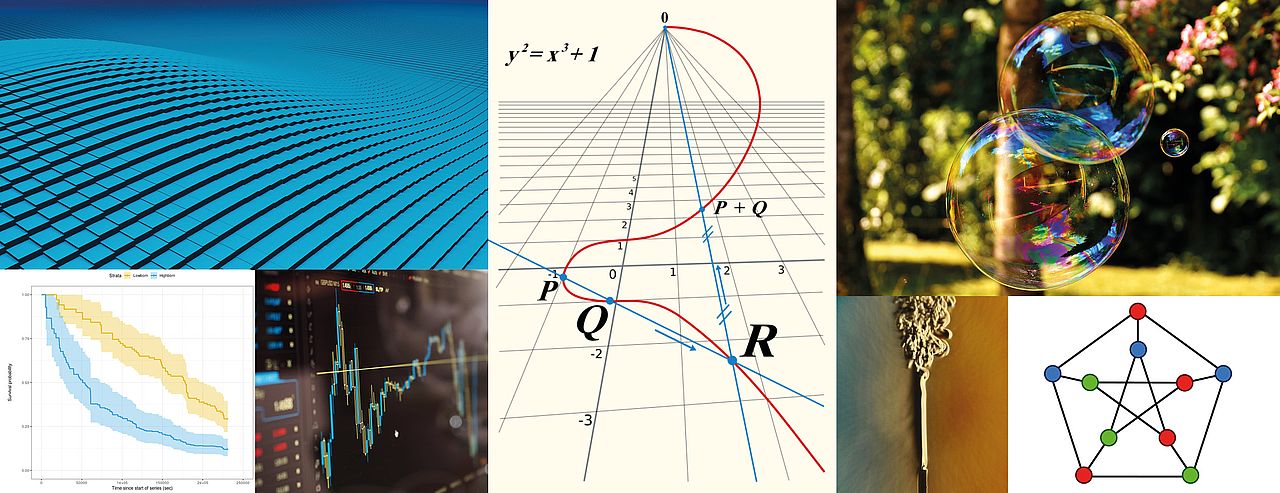
The Mathematical Colloquium is a joint scientific event organised by all the professors of Mathematics at the Faculty of Mathematics and Economics. The speakers are internationally recognised experts. The topics of the colloquia are current research areas in Mathematics and provide insights into different parts of Mathematics. Emphasis is placed on ensuring that the talks are designed for a broad mathematical audience so that all members of the faculty, especially young scientists and students, can benefit.
The colloquium usually takes place on Fridays at 10:15 am s.t., in Helmholtzstrasse 18, room 220.
As a rule, there is an opportunity to talk to the speaker over a cup of coffee or tea 30 minutes before the lecture.
| Datum | Uhrzeit | Vortragender | Einladendes Institut |
|---|---|---|---|
| 19.01.26 | 4:30 pm | Prof Dr Mark Peletier (TU Eindhoven), Titel: “Funny things may happen when using NNs to solve PDEs”. Abstract (From 4 p.m. on, there will be an opportunity to talk over coffee.) | Institute of Applied Analysis |
| 26.02.26 | 4:00 pm s.t. | Prof Dr Rupert Klein (FU Berlin), Titel: „Thoughts on Machine Learning”, Abstract | Institute of Numerical Mathematics |
| 15.05.26 | 10:15 am s.t. | Prof Sergey Foss (Heriot-Watt University, Edinburgh), Titel: TBA. Abstract | Institute of Stochastics |
| Datum | Uhrzeit | Vortragender | Einladendes Institut |
|---|---|---|---|
| 25.04.25 | 10:15 | Prof. Malka Gorfine (Universität Tel Aviv), Titel: “Confidence Intervals and Simultaneous Confidence Bands Based on Deep Learning”. Abstract | Institut für Statistik |
| 09.05.25 | 10:15 | Promotionsstudierende des Kooperativen Promotionskolleg Data Science und Analytics, Programm | Institut für Numerische Mathematik |
| 03.06.25 | 16:00 | Prof. Sergei Zuyev (Chalmers Universität für Technologie und Universität von Göteborg), Titel: “Training Bayesian neural networks with measure optimisation algorithms”. Abstract | Institut für Stochastik |
| Datum | Uhrzeit | Vortragender | Einladendes Institut |
|---|---|---|---|
| 29.11.24 | 10:15 | Prof. Greg Pavliotis (Imperial College London), Titel: Interacting particle systems and their mean field limit: phase transitions, control, and inference. Abstract | Institut für Angewandte Analysis |
| 17.12.24 | 11:00 | Prof. Felix Joos, Titel: The hypergraph removal process. Abstract | Institut für Optimierung und Operations Research |
| 07.02.25 | 10:15 | Prof.Dr. Guido Sweers (Universität Köln), Titel: “Elliptic boundary value problems on domains with corners”. Abstract | Institut für Angewandte Analysis |
| Datum | Uhrzeit | Vortragender | Einladendes Institut |
|---|---|---|---|
| 28.06.24 | 10:15 | Prof. Dr. Ilya Molchanov (Universität Bern) | Institut für Stochastik |
| 31.05.24 | 14:30 | Prof. Daniel Daners (Universität Sydney) (Abstract) | Institut für Angewandte Analysis |
| 26.04.24 | 10:15 | Prof. Dr. Christoph Thäle (Universität Bochum) |
| Datum | Uhrzeit | Vortragender | Einladendes Institut |
|---|---|---|---|
| 02.02.2024 | 10:15 | Promovierende des kooperativen Promotionskollegs Data Science und Analytics (Universität Ulm) Kurzvorträge ihrer Forschungsprojekte: Abhinav Das: Optimal Control of an Electricity Storage |
| Datum | Uhrzeit | Vortragender | Einladendes Institut |
|---|---|---|---|
| 11.11.22 | 14:30 | Prof. Dr. Massimo Fornasier (TU München) Consensus Based-Optimization | |
| 02.12.22 | 14:30 | Prof. Dr. Thomas Kruse (Universität Gießen)
(Abstract) | |
| 16.12.22 | 14:30 | Dr. Matthias Neumann (Universität Ulm) Data-driven stochastic 3D nanostructure modeling for virtual materials testing of battery materials | Institut für Numerik |
| 13.01.23 | 14:30 | Prof. Martin Plenio (Universität Ulm) Grundlagen der Resourcentheorien (Abstract) | |
| 20.01.23 | 14:30 | Prof. Dr. Jacobo Torán (Universität Ulm) Some connections between proof complexity and graph theory (Abstract) |
Mathematische Kolloquium Sommersemester 2022
| Datum | Uhrzeit | Vortragender | Einladendes Institut |
| 29.04.22 | --- | Kein Kolloquium: Absolventenfeier | |
| 06.05.22 | 14:30 | Prof. Dr. Ingo Steinwart (Uni Stuttgart) Abstract | Inst. Ang. Analysis |
| 20.05.22 | 14:30 | Prof.Dr. Christian Klingenberg (Uni Würzburg) Abstract | Inst. Ang. Analysis |
| 01.07.22 | 14:30 | Prof.Dr. Antje Hahn (Hochschule Darmstadt) Abstract | Inst. für Statistik |
| 15.07.22 | 14:30 | Prof.Dr. Reinhard Hochmuth (Uni Hannover) und Frau Laura Burr (Uni Ulm) | Inst. Ang. Analysis |
| Datum | Uhrzeit | Vortragender | Einladendes Institut |
| 5.11.21 | 14:30 | Prof. Dr. Michael Vogt (Uni Ulm) Tuning Parameter Calibration and Inference for the Lasso | Inst. Ang. Analysis |
| 10.12.21 | 14:30 | Priv.Doz.Dr. Imma Curato (Uni Ulm) Light cones and suprevised learning prediction tasks | Inst. Ang. Analysis |
| 14.1.22 | 14:30 | Prof. Dr. Jakob Runge (DLR, TU Berlin) Causal inference and causal discovery (with perspectives in Earthe sciences) | Doktoranden der Mathematik |
| 28.1.22 | 14:30 | Prof. Dr. Gitta Kutyniok (LMU München) The Mathematics of Deep Learning | Doktoranden der Mathematik |
| Datum | Uhrzeit | Vortragender | Einladendes Institut |
|---|---|---|---|
| 28.05.2021 | 14.30 | Gabriel Peyré, CNRS and Ecole Normale Supérieure Scaling Optimal Transport for High dimensional Learning | Doktoranden der Mathematik |
| 18.06.2021 | 14:30 | Prof.Dr. Henning Bruhn-Fujimoto Super-resolution in der Mikro-Röntgenfluoreszenzanalyse | Institut für Angewandte Analysis |
| Datum | Uhrzeit | Vortragender | Einladendes Institut |
|---|---|---|---|
| 11.12.2020 | 14:30 | Prof. Dr. Nelly Litvak, University of Twente and Eindhoven University of Technology, Netherlands Ranking of nodes in large radom networks | Doktoranden der Mathematik |
| 22.01.2021 | 14:30 | Dr. Tim Laux, Institute for Applied Mathematics, University of Bonn The Allen-Cahn equations and mean curvature flow | Institut von Analysis, Institut von Angewandte Analysis |
| 29.01.2021 | 14.30 | Prof. Dr. Jeroen Sijsling, Institut für Algebra und Zahlentheorie, Universität Ulm Datenbanken von Kurven und Modularität | Dekanat |
| 05.02.2021 | 14:30 | Prof. Dr. Christian Hirsch, University of Groningen The persistence diagram: A tool for spatial statistics at many scales | Doktoranden der Mathematik |
| Datum | Uhrzeit | Vortragender | Einladendes Institut |
|---|---|---|---|
| 10.07.2020 | 14:30 | Prof. Dr. Tilmann Gneiting (Heidelberg Institute for Theoretical Studies) Erfolge und Grenzen der Wettervorhersage - eine mathematische Perspektive | Doktoranden der Mathematik |
| Datum | Uhrzeit | Vortragender | Einladendes Institut |
|---|---|---|---|
| 25.10.19 | 14:30 | Prof. Dr. phil. Martin Poppe (Fachhochschule Münster) Towards a better understanding of electromagnetic fields | Doktoranden der Mathematik |
| 08.11.19 | 14:30 | Dr. Sarat Moka (University of Queensland, Brisbane)
(Abstract) | Institut für Stochastik |
| 22.11.19 | 14:30 | Prof. Dr. Folkmar Bornemann (Technische Universität München) Finite Size Effects: Random Matrices, Quantum Chaos and Riemann Zeros | Institut für Numerik |
| 6.12.19 | 14:30 | Dr. James Kennedy (Universidade de Lisboa) The Shape of Sound (Abstract) | Doktoranden der Mathematik |
| 17.01.20 | 14:30 | Prof. Dr. Gianluca Crippa (Universität Basel) How to optimally stir your coffee: Challenges in differential equations (Abstract) | Institut für Angewandte Analysis |
| 31.01.20 | 14:30 | Dr. Stefan Glock (University of Birmingham/ ETH Zürich) High-Dimensional Equipartitions - how a blend of algebraic, combinatorial and probabilistic methods solved a 150 year old maths problem (Abstract) | Doktoranden der Mathematik |
Prof Dr Jan Beyersmann
Helmholtzstraße 20 Room E.44
89081 Ulm
Mail: jan.beyersmann(at)uni-ulm.de
Tel: (+49) 731/ 50 33100