


Research interests
I am interested in the complex interactions between host environment and host health and fitness in a changing world. I currently want to answer the question how anthropogenic changes affect host diet and its environment and how this translates to both composition and function for the host microbiome. To assess both diet and microbiome function, I am using genomic and metagenomic approaches.
- Wildlife gut microbiome and health
- Diet analysis
- Metagenomics
- Immunogenetics
- Host-pathogen interaction
- Anthropogenic influence
Scientific projects
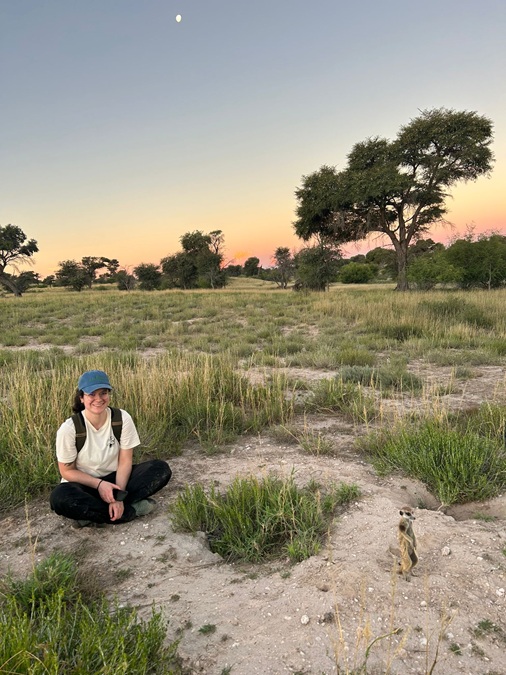
My research focuses on the tri-trophic interaction between climate, diet, and the gut microbiome in the Kalahari meerkat (Suricata suricatta) and how these factors affect meerkat health and fitness. In my master thesis, I investigated the evolutionary arms race between meerkat immune genes, specifically the Major Histocompatibility Complex (MHC) and Tuberculosis (TB). I used high throughput sequencing and pedigree data to assign MHC-haplotypes to analyse how MHC affects TB susceptibility, progression and meerkat mortality and whether TB in turn functions as a selective force on the MHC (Müller-Klein et al. 2025). For my PhD research, I shifted to the functional and taxonomic responses of the meerkat gut microbiome. We continue investigating the effects of TB infection on meerkats, focussing on the gut microbial community. Additionally, I am specifically interested in whether climate-driven changes in food availability, rather than temperature alone, trigger microbial shifts that compromise hosts.
- Within the broader framework of the Kalahari Meerkat Project, I am investigating in two critical areas:
Long-term Diet Reconstruction: I am utilizing DNA metabarcoding and shotgun metagenomics to analyse fecal samples spanning 30 years. My goal is to reconstruct the meerkats' dietary history with high taxonomic resolution, identifying shifts in prey diversity that may have occurred as the Kalahari climate has warmed. - Microbial & Functional Mapping: Using a dataset of over 2000 samples, I am tracking the evolution of the gut microbiome over three decades. By applying metagenomic sequencing, I aim to disentangle the direct effects of abiotic stressors from the indirect effects of diet, body condition, and TB status on microbial health.
By integrating 30 years of data, my work seeks to identify the mechanisms of microbial dysbiosis in wild populations. This research is vital for understanding how climate change and disease interact to influence the long-term viability of social mammals in semi-desert ecosystems.
Publications
Víquez-R, L., Henrich, M., Riegel, V. et al. A taste of wilderness: supplementary feeding of red deer (Cervus elaphus) increases individual bacterial microbiota diversity but lowers abundance of important gut symbionts. anim microbiome 6, 28 (2024).
https://doi.org/10.1186/s42523-024-00315-6
Müller-Klein, N., Risely, A., Wilhelm, K., V. Riegel et al. Twenty years of tuberculosis-driven selection shaped the evolution of the meerkat major histocompatibility complex. Nat Ecol Evol 9, 2161–2172 (2025).
https://doi.org/10.1038/s41559-025-02837-x
Conference contributions
ESEB Barcelona 2025: Poster presentation “Twenty-years of Tuberculosis-driven selection shaped the evolution of meerkat MHC”
Contact
- Vanessa Riegel, MSc.
Institute of Evolutionary Ecology
and Conservation Genomics
University of Ulm
Albert-Einstein-Allee 11
89081 Ulm
Germany
Email: vanessa.riegel()uni-ulm.de