


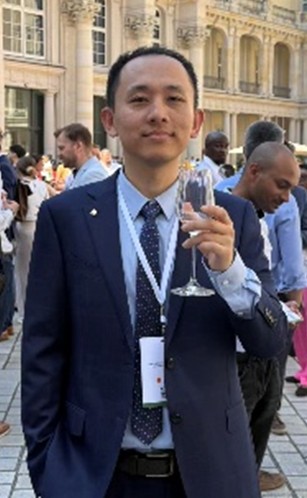
Dr. Bin Tuo
Research interests
- Interactive effects of climate, functional traits, and biotic interactions across trophic groups on decomposition and associated biodiversity under human disturbance and global change
- Vertebrate effects on deadwood properties, flammability, and fire ecology
- Global synthesis and experimental approaches linking biodiversity and decomposition.
Publications (Selected)
B, Tuo., L, Lin., RS, Rantwijk., RSP, van Logtestijn., L, Goudzwaard., MP, Berg., MM, Hefting., U, Sass-Klaassen., K, Scheffers., JHC, Cornelissen. Positive feedback from woodpeckers on deadwood decomposition via invertebrates, Current Biology, 35, p2732-2739.e4.
B, Tuo., YK, Hu., RSP van, Logtestijn., J, Zuo., L, Goudzwaard., MM, Hefting., MP Berg., JHC Cornelissen. (2024). Facilitation: Isotopic evidence that wood-boring beetles drive the trophic diversity of secondary decomposers. Soil Biology and Biochemistry, 109353.
Guo, C., Tuo, B., Seibold, S., Ci, H., Sai, B.-L., Qin, H.-T., Yan, E.-R. and Cornelissen, J. . (2024), Seasonally Changing Interactions of Species Traits of Termites and Trees Promote Complementarity in Coarse Wood Decomposition. Ecology Letters, 27: e70002.
B, Tuo., P, García-Palacios., C, Guo., ER, Yan., MP, Berg., JHC, Cornelissen. (2024). Meta-analysis reveals that vertebrates enhance plant litter decomposition at the global scale. Nature Ecology & Evolution, 1-12.
B, Tuo., ER, Yan., C, Guo., H, Ci., MP, Berg., JHC, Cornelissen. (2021). Influences of the bark economics spectrum and positive termite feedback on bark and xylem decomposition. Ecology 102 (10), e03480.
Postdoctoral project:
Understanding how land-use and climate change reshape detrital food webs is essential for predicting their consequences for forest carbon and nutrient cycling. Using a global network of paired natural and plantation forests across 45 sites, I will investigate how forest conversion interacts with macroclimate to alter the structure of detrital food webs and how these changes are linked to deadwood decomposition. Furthermore, using a complementary experiment across 64 plots along an elevational and canopy-openness gradient in Berchtesgaden National Park, Germany, I will examine the mechanisms underlying these global patterns by assessing how microclimate, habitat structure, substrate quality, and invertebrate access jointly shape decomposer communities, food-web structure, and decomposition across multiple organic susbstrates.
By conducting this research, my goal is to provide a comprehensive assessment of how climate, forest conversion, resource quality, and decomposer interactions jointly regulate detrital food webs and decomposition. This work will help move biodiversity research beyond species richness and composition toward understanding how the architecture of biotic interactions contributes to ecosystem functioning and forest resilience under global change.
CV
Since 2026
Alexander von Humboldt Postdoctoral Fellow, Ecosystem Resilience Group, Ulm University, Germany, with Prof. Sebastian Seibold
2024–2026
Postdoctoral Researcher, Vrije Universiteit Amsterdam, the Netherlands, with Prof. J. Hans C. Cornelissen
2019-2024
PhD in Ecology, Vrije Universiteit Amsterdam, the Netherland. Supervisor: Prof. J. Hans C. Cornelissen
2016-2019
Master’s in Ecology, East China Normal University, China. Supervisor: Prof. Enrong Yan
Contact
Institute of Evolutionary Ecology
and Conservation Genomics
Ulm University
Albert-Einstein-Allee 11
D-89081 Ulm, Germany
Office: M25 4114
bin.tuo()uni-ulm.de
ORCID: 0000-0001-6215-955X
Google Scholar: https://scholar.google.com/citations?user=LxXCBg4AAAAJ&hl=en