Human-Centered Software Engineering Research Group

Institute of Software Engineering and Programming Languages,
Prof. Dr. Matthias Tichy

Empowering Humans to Drive the Digital Revolution

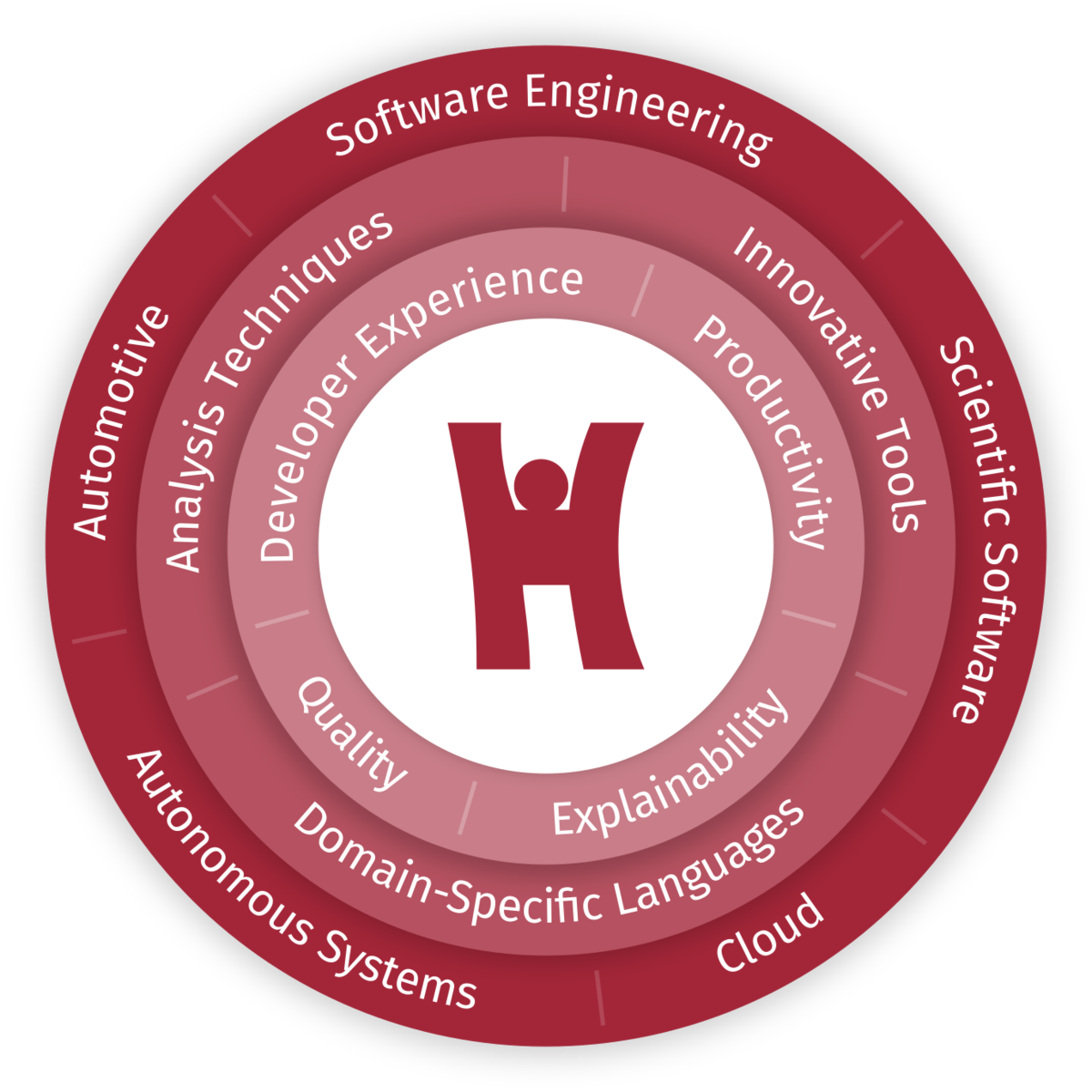
Software is ultimately developed for and by humans. Consequently, we – the Human-Centered Software Engineering Research Group – focus our software engineering research on supporting and empowering humans to drive the digital revolution.

We do this by aiming at reducing complexity, avoiding defects, and improving developer resp. user experience. We realize this by developing domain-specific languages, quality assurance techniques, and innovative tools. To ensure high-quality research, we apply incremental/iterative design science research to arrive at evaluated solutions and empirical research methods to systematically identify research opportunities and properly show the benefits of our research results. Our research targets embedded systems, particularly automotive software, self-adaptive systems, and software in general as application areas.

Team

M.Sc. Raphael Straub

Raphael Straub
M.Sc. Raphael Straub
Research Assistant
Ulm University
Institute of Software Engineering and Programming Languages
Albert-Einstein-Allee 11
89069 Ulm

Research Projects

Tools to accelerate innovation along the automotive value chain

Self-organizing resilient execution platform for IoT services

Model-based Explainable Coordination of Complex Reconfigurations
Integrated Safety and Security Engineering of Self-Adaptive Systems.

Publications

2026

112.
Neumüller, Denis; Boll, Sebastian; Schüler, David; Tichy, Matthias
Combining Static Code Analysis and Large Language Models Improves Correctness and Performance of Algorithm Recognition
33. International Conference on Software Analysis, Evolution and Reengineering (SANER)
Herausgeber: IEEE
2026
ISBN:979-8-3315-8582-2
Datei:http://arxiv.org/abs/2604.03048
111.
Sihler, Florian; Pfrenger, Lars; Gerstl, Oliver; Tichy, Matthias
Towards Automatically Inferring Constraints to Identify Implicit Assumptions in Data Analysis
2026 IEEE/ACM 48th International Conference on Software Engineering (ICSE-NIER ’26)
2026
DOI:10.1145/3786582.3786806

2025

110.
Neumüller, Denis; Raschke, Alexander; Tichy, Matthias
Providing Information About Implemented Algorithms Improves Program Comprehension: A Controlled Experiment
29. International Conference on Evaluation and Assessment in Software Engineering (EASE)
Dezember 2025
DOI:10.1145/3756681.3756968
Datei:https://arxiv.org/pdf/2504.19225
109.
Sihler, Florian; Tichy, Matthias
Statically Analyzing the Dataflow of R Programs
Proceedings of the ACM on Programming Languages, OOPSLA 2025, Seite 1034-1062
Oktober 2025
DOI:10.1145/3763087
108.
Straub, Raphael; Sihler, Florian; Torbati, Ali; Wang, Cong; Groner, Raffaela; Klös, Verena; Tichy, Matthias
Explainability in Self-Adaptive Systems: A Systematic Literature Review
Euromicro Conference on Software Engineering and Advanced Applications 2025,
September 2025
DOI:10.1007/978-3-032-04200-2_19
107.
Straub, Raphael; Stiess, Sarah Sophie; Becker, Steffen; Tichy, Matthias
Model-Based Proactive Self-adaptation for Cloud Systems
European Conference on Software Architecture 2025,
August 2025
DOI:10.1007/978-3-032-02138-0_12
106.
Pietron, Jakob; Jutz, Benedikt; Raschke, Alexander; Tichy, Matthias
EditQL: A Textual Query Language for Evolving Models
Software Engineering 2025, Karlsruhe, Germany
Februar 2025
DOI:10.18420/se2025-22
105.
Sihler, Florian; Pietzschmann, Lukas; Straub, Raphael; Tichy, Matthias; Diera, Andor; Dahou, Abdelhalim
On the Anatomy of Real-World R Code for Static Analysis (Extended Abstract)
Herausgeber: Gesellschaft für Informatik, Bonn
Februar 2025
DOI:10.18420/se2025-27
104.
Pietron, Jakob; Raab, Heiko; Tichy, Matthias
Adaptive caching for operation-based versioning of models
Software and Systems Modeling
Januar 2025
DOI:10.1007/s10270-024-01214-9

2024

103.
Straub, Raphael; Stiess, Sarah Sophie; Becker, Steffen; Tichy, Matthias
ADVISE: Understanding Reconfigurations in Self-Adaptive Cloud Systems
2024 IEEE Working Conference on Software Visualization (VISSOFT),
Dezember 2024
DOI:10.1109/VISSOFT64034.2024.00026