Extra-occupational Master’s Degree Programme Sensor Systems Engineering (M.Sc.)

Sensor technology, the core topic of the master's degree programme "Sensor Systems Engineering", is one of the key technologies of our modern world. Sensor systems engineering includes design methods as well as control, communication and information technologies that make it possible to control the complexity of systems. The trend in sensor technology leads to increasingly complex systems. These systems evaluate diverse sensors, compile their data appropriately and make them available to the user in prepared form. More and more signals are evaluated mechanically (automatically) in order to draw conclusions from existing data and initiate courses of action. Sensor systems ensure the efficient use of resources in control loops, increase the safety of vehicles, protect health and life in medicine, and form a protective shield against terrorist attacks.

Prerequisites: one year of qualified professional experience after the first higher education degree or academic degree with 180 ECTS + two years of qualified professional experience after the first higher education degree

ECTS Credits: 90

Fees: 12.200 - 14.900 €

Start of study: Winter semester: October | Sommer semester: April

Teaching language: German and English; Proof of language skills in german and in english

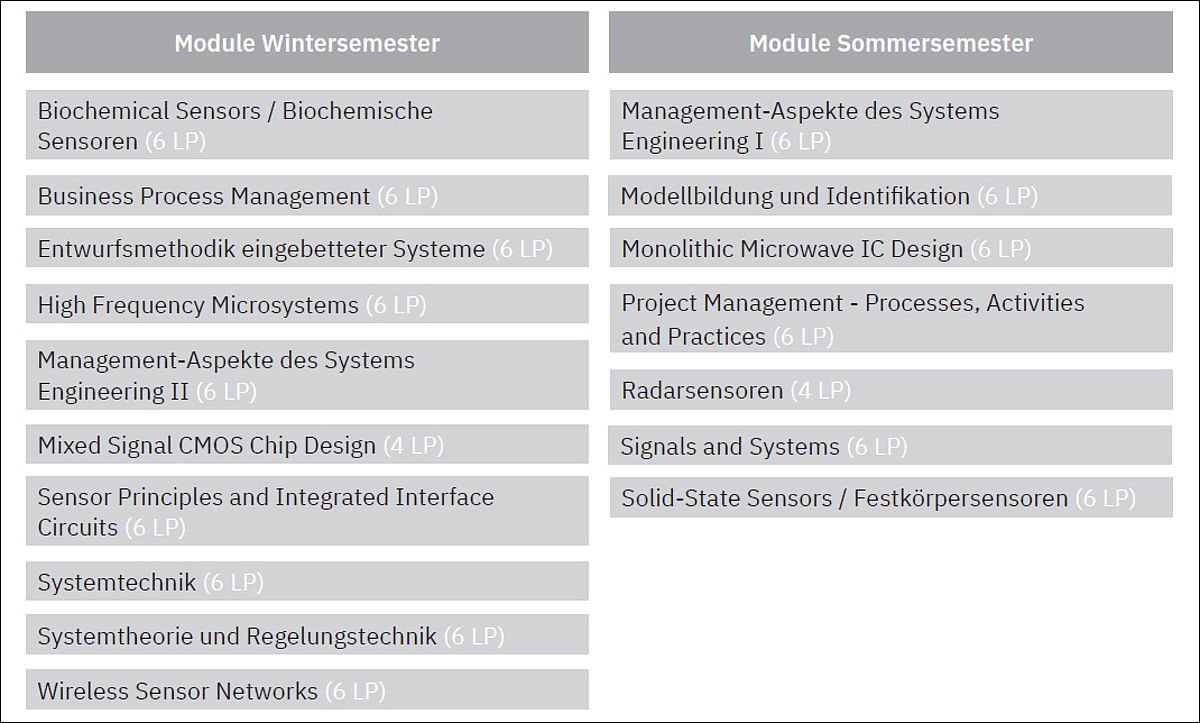
Module groups and modules

Fundamentals of systems engineering

The module teaches methods of mathematical modeling of technical processes based on physical principles. The particular aim is to enable students to derive suitable models for controller and observer design and to parameterize them using identification methods.

Semester time: winter semester

Credits points according to ECTS: 6

Fee upon enrollment: 1.170 Euro
Fee for contact studies: 1.290 Euro

To the module

Students acquire knowledge about different methods and algorithms of pattern recognition and deep artificial neural networks. In exercises, students are able to implement the basic algorithms, will apply pattern recognition principles to technical applications, and learn how to evaluate the performance of classifiers.

Semester time: winter semester

Credits points according to ECTS: 6

Fee upon enrollment: 1.170 Euro
Fee for contact studies: 1.290 Euro

To the module

The concepts of signals and systems are powerful tools for any engineer dealing with information bearing, measurable physical quantitites. Areas of applications include, among others, communications engineering, signal processing, control engineering, and systems engineering.

Semester time: winter semester

Credits points according to ECTS: 6

Fee upon enrollment: 1.170 Euro
Fee for contact studies: 1.290 Euro

To the module

Systems engineering describes methods, strategies and procedures for handling complex projects.

Semester time: winter semester

Credits points according to ECTS: 6

Fee upon enrollment: 1.170 Euro
Fee for contact studies: 1.290 Euro

To the module

To an increasing degreee, requirements on safety, sustainability and economic feasibility of technical products and production plants call for modern approaches of control-theory-based methods. Especially in the environment of control theory, simple and heuristically designed controllers have been reaching their limits. Systematic design of model-based controllers in time domain allows considering of non-linearities and has the potential to achieve significantly improved controller results.

Semester time: winter semester

Credits points according to ECTS: 6

Fee upon enrollment: 1.170 Euro
Fee for contact studies: 1.290 Euro

To the module

Management Aspects

In this module participants learn to analyze, model and optimize business processes at a technical level. They also gain in-depth insights into their digital transformation and automation using process-oriented information systems. They can identify the requirements for implementing process-oriented information systems, describe the key characteristics, components and functions of such information systems and classify them within an overall architecture.

Semester time: winter semester

Credits points according to ECTS: 6

Fee upon enrollment: 1.500 Euro
Fee for contact studies: 1.620 Euro

To the module

System Engineering is an interdisciplinary approach. This means that several specialist engineering disciplines and domain experts are involved in the system realization. Systems engineers establish an interaction and communication network with customers, users and stakeholders and other organizational units of the enterprise. They need to consider the complete life cycle of a system. This module invites you to learn more about the role of a systems engineer and the management of large projects.

Semester time: summer semester

Credits points according to ECTS: 6

Fee upon enrollment: 1.170 Euro
Fee for contact studies: 1.290 Euro

To the module

After working through this course you will be able to explain risk and opportunity management and the reasons for its application. You will describe the differences between safety and security and you will be aware of some major standards in his area and their application domain. A second focus of the course is model-based systems engineering (MBSE) enabling a more efficient and structured way to manage and design complex systems.

Semester time: winter semester

Credits points according to ECTS: 6

Fee upon enrollment: 1.170 Euro
Fee for contact studies: 1.290 Euro

To the module

In the certificate course Project Management - Processes, Activities and Practices you will learn techniques and processes based on best practices from the project management community and apply them in practical examples. You will learn about the challenges, you will encounter in project management and will be able to weigh up measures in areas such as risk and opportunity management or quality management in order to make informed decisions and ensure the success of your project.

Semester time: summer semester

Credits points according to ECTS: 6

Fee upon enrollment: 1.170 Euro
Fee for contact studies: 1.290 Euro

To the module

System Design

In taking part in the module “Design of Embedded Real-Time Systems” the students learn how to describe and sketch the model-based design of embedded systems. The participants will be enabled to build new methods and algorithms and to prove their correctness.

Semester time: winter semester

Credits points according to ECTS: 6

Fee upon enrollment: 1.170 Euro
Fee for contact studies: 1.290 Euro

To the module

The students identify different areas of application for compact high-frequency systems and microwave systems in telecommunication and sensors.

Semester time: winter semester

Credits points according to ECTS: 6

Fee upon enrollment: 1.170 Euro
Fee for contact studies: 1.290 Euro

To the module

This lecture goes along with the analog and digital CMOS circuit design lectures offered by the institute of microelectronics. In contrast to these more theoretical lectures on circuit design techniques, this lecture is focused on the implementation issues of application specific integrated circuits (ASICs).

Semester time: winter semester

Credits points according to ECTS: 4

Fee upon enrollment: 780 Euro
Fee for contact studies: 860 Euro

To the module

This module imparts a general overview of monolithic microwave IC (MMIC) design techniques, design tools and models as well as practical design exercises. Students will also deal with substrate properties, packaging parasites and their influence on MMIC design and fundamental building blocks.

Semester time: summer semester

Credits points according to ECTS: 6

Fee upon enrollment: 1.170 Euro
Fee for contact studies: 1.290 Euro

To the module

Students can explain the essential requirements and unique challenges of wireless ad-hoc networking; they can identify differences to classical wired networks and explain them.

Semester time: winter semester

Credits points according to ECTS: 6

Fee upon enrollment: 1.170 Euro
Fee for contact studies: 1.290 Euro

To the module

Sensorik

This module imparts a general overview of biosensors with different points of focus, such as the basics of chemistry and molecular biology, biological detection methods, physical transduction methods, and immobilization techniques as well as biochip technologies.

Semester time: winter semester

Credits points according to ECTS: 6

Fee upon enrollment: 1.170 Euro
Fee for contact studies: 1.290 Euro

To the module

This module is intended to introduce learners to the subject and also focus on recent developments. Upon completion of the module, students should be able to apply principles of high-frequency technology and microwave technology to the design and metrological testing of radio measurement technology systems (radar technology).

Semester time: summer semester

Credits points according to ECTS: 4

Fee upon enrollment: 660 Euro
Fee for contact studies: 780 Euro

To the module

The students can identify the most relevant noise sources in sensors and sensor readout electronics and predict their effect on the achievable limit of detection.

Semester time: winter semester

Credits points according to ECTS: 6

Fee upon enrollment: 1.170 Euro
Fee for contact studies: 1.290 Euro

To the module

This module imparts a general overview of solid-state sensors with different points of focus, such as sensor system design, operational amplifiers, and solid-state physics. In addition, various semiconductor-based detection methods for  radiation (ionizing and non-ionizing), magnetic fields, mechanical forces, and temperature. In addition, the students are intensively dealing with the fundamentals of MEMS.

Semester time: summer semester

Credits points according to ECTS: 6

Fee upon enrollment: 1.170 Euro
Fee for contact studies: 1.290 Euro

To the module

Students can explain the essential requirements and unique challenges of wireless ad-hoc networking; they can identify differences to classical wired networks and explain them.

Semester time: winter semester

Credits points according to ECTS: 6

Fee upon enrollment: 1.170 Euro
Fee for contact studies: 1.290 Euro

To the module

Master’s Thesis

Die Studierenden erweitern im Rahmen dieses Moduls die Fähigkeit, ein Thema aus der aktuellen Forschung im Bereich der Sensorsystemtechnik unter Beachtung wissenschaftlicher Kriterien selbständig zu erarbeiten und darüber eine schriftliche Arbeit zu verfassen, welche in ihrer Form allen Ansprüchen an wissenschaftliche Texte genügt.

Leistungspunkte nach ECTS: 30

Studiengebühr: 4.500 Euro* oder 1.800 Euro**

Zum Modul

* Bei Durchführung der Masterarbeit an der Universität wird den Studierenden für die Dauer der Arbeit ein komplett eingerichteter Büroraum mit Zugriff auf die Ressourcen des Instituts, in dem die Masterarbeit angefertigt wird, zur Verfügung gestellt.

** Bei Durchführung der Masterarbeit außerhalb der Universität steht die Infrastruktur des Instituts des betreuenden Dozenten für die Anfertigung der Arbeit nicht zur Verfügung.

Programme Director

Prof. Dr.-Ing.
Frank Slomka

Programme Coordinator

Steffen Moser

Study Objectives

The master's degree programme Sensor Systems Engineering combines hardware, software and infrastructure aspects with design techniques and elements of the management of complex design processes. Through this interactive approach, results can be achieved that cannot be reached by considering the individual elements separately. Successful graduates master special fields of engineering, computer science and natural sciences as well as relevant management aspects.

After successfully completing the master's degree programme Sensor Systems Engineering with both research and practice-oriented studies, the students gain outstanding specialist knowledge and excellent skills for tasks in the technical environment and at the interface to management.


Learning outcomes of the degree programme

Successful graduates of the master's degree programme in sensor systems engineering are familiar with superordinate aspects of systems engineering, including project, risk, and quality management, which enable them to design and implement even more complex sensor systems. They are familiar with the relevant instruments of control engineering, they can apply procedures for the design of embedded systems in a targeted manner and know sensor components with sufficient profundity to apply them ideally in their systems.

Degree of the programme Master of Science (M.Sc.) Diploma of Advanced Studies (DAS) Contact studies (certificate)
Coursework 90 ECTS-Punkte (incl. master thesis) at least 30 credit points modules within the scope from 4 to 6 credit points
Modules

1 ECTS corresponds to approx. 30 hours workload

Standard period of study 6 - 8 semesters 2 - 3 semesters 1 semester
Study organisation approx. 80% self-study phases and 20% on-campus meetings
Structure/content From each module group (basics of systems engineering, sensor technology, system design and management aspects) a minimum of 12 credit points must be proven. The remaining ECTS are covered by a master thesis of 30 credit points. It can be chosen from three points of focus: Embedded Systems, Systems Engineering or Sensor Technology. In each case 4 (or 5) required (or elective) modules of 3 – 6 ECTS each must be taken. In addition, a final thesis of 6 credit points must be written. Contact students can choose from all modules of the programme.
Application deadlines January 15th or July 31st March 15th or September 15th
Costs At the time of enrolment,  tuition fees and various contributions must be paid. Details of the DAS and the fees For the certificate courses in contact studies, fees vary depending on the scope of the module.
Prerequisites - academic degree with 210 ECTS + one year of qualified professional experience
or
- academic degree with 180 ECTS + two years of qualified professional experience
1st academic degree
Accreditation Accredited until spring 2030
Contact and advice Pleas use our contact formula or send a message to saps(at)uni-ulm.de.
You can reach us by phone under +49 (0)731/50-32401!

More information and documents