Duration of apprenticeship | 3 1/2 years, shortening possible
Admission requirements | Very good Certificate of Secondary Education, Intermediate School Leaving Certificate
Vocational School | Robert-Bosch-Schule Ulm
What does the training offer you?
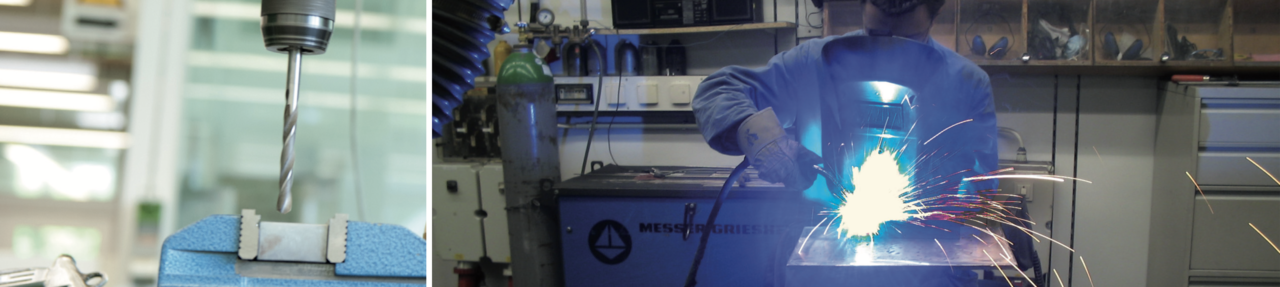
Training as a metalworker mainly takes place in the scientific workshop. In the field of construction technology, metalworkers manufacture and assemble components for metal and steel structures. Your products are often unique items manufactured specifically to customer requirements. Using technical drawings, you will process light metals, steel and plastics by hand or using machines, e.g. by marking out, cutting, forming, welding, riveting, screwing and gluing. You will also carry out repair, maintenance and servicing work.
After completing your examination as a metalworker specialising in construction technology, you will find employment opportunities primarily in metal construction companies. The construction sector uses sturdy steel structures or custom-made conservatories, metal roofing and metal facades, railings, doors and gates with locking and security systems, and stainless steel or aluminium windows. Many elements of modern architecture are produced by metalworkers. You will usually work in workshops, factory halls or on construction sites for assembly work, sometimes outdoors.
After your training, there are many further training opportunities open to you. As a metalworker, you can train to become a master craftsman or technician, or pursue a degree in metal construction, for example.
What makes training at the university so special?
Here, you will not only learn the typical basics of the profession in a team, but you will also see something new every day: we exclusively produce items for research and teaching at the university: devices that are still in the testing phase; individual parts that need to be adapted; experimental setups for lectures; things that do not even exist yet... Almost anything is possible. The approximately 4,000 employees and over 10,000 students at the university need our expertise in the workshop for interesting and exciting projects involving a wide variety of materials, which you will be working on.
What should you bring with you?
An interest in technology
Enjoyment of manual work
Mobility and flexibility
Logical and spatial thinking
Ability to work in a team
Ability to work independently
Carefulness
Reliability
What can you count on?
Holidays: determined by collective agreement in accordance with TVA-L BBiG
Payment: determined by collective agreement in accordance with TVA-L BBiG
1st year of training: attendance at a one-year industrial and technical vocational school
2nd–4th year of training: one fixed vocational school day per week, 1–2 additional days per month