


Big Data Analytics - Methoden und Anwendungen
Overview and learning objectives
Nowadays, companies have access to very extensive and ever-growing amounts of data - for example via social media and the Internet (e.g. online social networks, wikis, rating and review communities, discussion forums), but also in traditional databases (e.g. data warehouses, customer databases). The targeted and well-founded analysis of this data enables improved decision support and harbours great potential in a wide range of application areas (e.g. innovation management, product development, marketing, customer relationship management, internal knowledge management). In the module "Big Data Analytics - Methods and Applications" , the necessary fundamentals and methods are taught and applied to specific examples. Students who have successfully completed this module know the essential theoretical fundamentals, potential applications and risks of big data analytics and can explain them. They are familiar with various methods for analysing extensive amounts of structured and unstructured data (e.g. collaborative and content-based filtering in the field of recommender systems, neural networks in the field of text mining and recurrent neural networks in the field of smart vehicles) and are able to assess and apply them. In addition, they are able to use these methods to solve practical problems (e.g. analysing real data sets using Python), interpret the results and derive recommendations for action.
Lecturers



Course information
This module covers the following subject matter:
- Introduction and fundamentals
- Big Data Analytics as a highly relevant topic
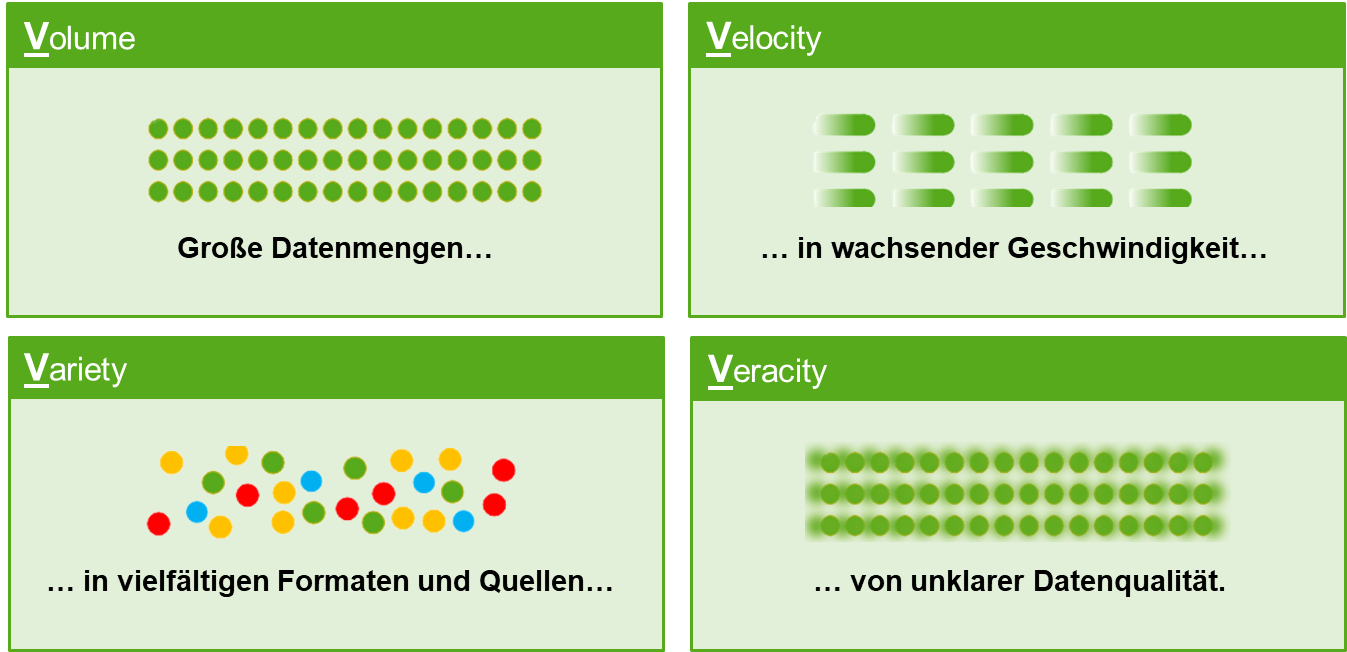
- Characteristics, opportunities and risks of Big Data
- Potential applications and (economic) potential of Big Data Analytics
- Big Data Analytics – selected application areas and methods
- Recommendation systems (e.g. collaborative filtering, content-based filtering)
- Text mining (e.g. vector space model, word embeddings and neural networks)
- Smart vehicles (e.g. recurrent neural networks)
- Big Data Analytics – practical applications
- Analysis of real-world datasets using Python
- Addressing practical problems, interpreting results and deriving recommendations for action
This module covers the following subject matter:
- Big Data Analytics (BDA)
- Fundamentals and methods for the targeted and informed analysis of structured and unstructured data
- Potential applications and risks of Big Data Analytics
- Leskovec, J., Rajaraman, A., Ullman, J.-D. (2014) Mining of Massive Datasets.
- Loshin, D. (2013) Big Data Analytics: from Strategic Planning to Enterprise
- Mikolov, Tomas, et al. (2013) Efficient estimation of word representations in vector space. arXiv:1301.3781
- Devlin, Jacob, et al. (2018) Bert: Pre-training of deep bidirectional transformers for language understanding. arXiv:1810.04805
Organizational information
Next course start: SoSe 27
Term & Place: tbd
Lecture (2 SWS) with exercise (2 SWS)
Credit points are awarded upon passing the written module examination. Registration for this examination does not require prior academic achievement.
The module mark corresponds to the result of the module examination.
Specialisation subjects: Technology and Process Management, Business Analytics, Business Management and Controlling, Accounting and Auditing, Compulsory Elective in Business Administration.
Degree programmes: M.Sc. in Economics, M.Sc. in Business Informatics - Digital Business and Analytics, M.Sc. in Mathematical Economics, M.Sc. in Economic Chemistry, M.Sc. in Economic Physics, M.Sc. in Sustainable Business Management, M.Sc. in Artificial Intelligence, M.Sc. in Mathematical Data Science, M.Sc. in Finance, M.Sc. in Computational Science Engineering, and degree programmes with Economics as a minor subject.