
Contact person
Steffen Zimmermann
Head of the Institute of Business Analytics
Ulm University
Helmholtzstraße 22, 89081 Ulm
Consultation hours:
Appointment by arrangement (enquiry in advance by e-mail to steffen.zimmermann(at)uni-ulm.de)




The digital transformation is now affecting all sectors of the economy. Both manufacturing companies and companies in the service sector are facing comprehensive and lasting changes in order to remain successful on the market in the future. Changes affect the range of services, processes, business models, value creation systems and sales markets.
The Business Analytics specialisation prepares students for future entrepreneurial challenges associated with the digital transformation. Students acquire basic skills in storing, processing and analysing data in order to make better business-relevant decisions.
Students in this specialisation learn about the basic concepts, models and methods of business analytics. These are divided thematically into three areas: big (social) data analytics, digital business and value creation management.
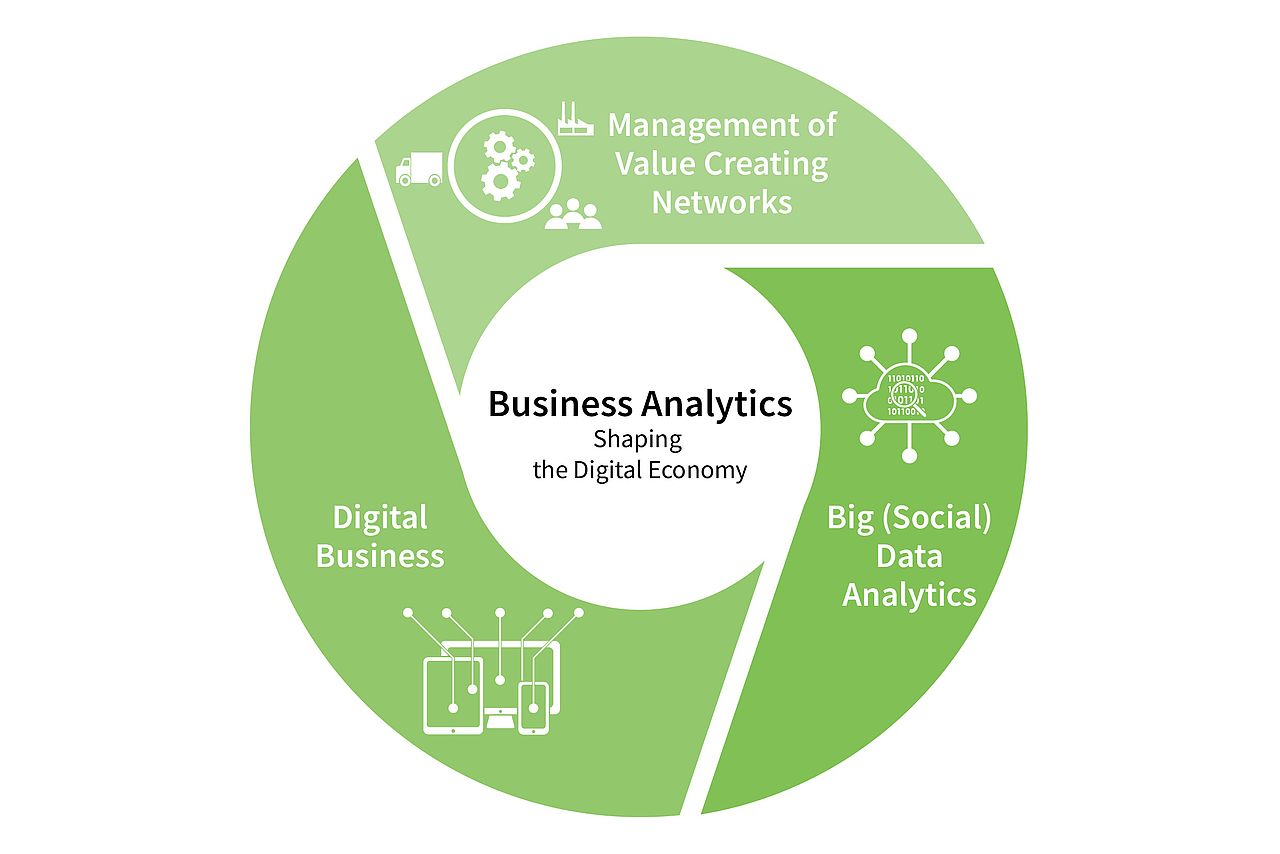
Today, companies have access to very large and ever-growing amounts of data - for example via social media and the Internet (e.g. online social networks, wikis, rating and review communities), but also in traditional databases
(e.g. data warehouse, customer databases). The question arises as to how useful business knowledge can be extracted from this flood of data - often referred to as "big data". Answers - e.g. based on modern methods of social network analysis or machine learning (e.g. neural networks) - are provided by big (social) data analytics as a central area within business analytics.
The topic of digital business also plays a central role in the successful realisation of digital transformation and therefore in the context of business analytics. Digital business describes the merging of the digital and physical worlds, for example in the form of new business models and processes. Companies must therefore be able to react quickly to new opportunities and threats in digital business. This requires new management skills, organisational structures and methods.
Business models and value creation systems as a whole are also affected by the digital transformation. Digital platforms in particular have disruptive potential and make modern value creation management a central component of business analytics. Digital platforms are fundamentally changing entrepreneurial activity by establishing a new level of competition and value creation. In future, competition will no longer take place between companies, but rather between value creation networks and digital platforms.
Contact person
Steffen Zimmermann
Head of the Institute of Business Analytics
Ulm University
Helmholtzstraße 22, 89081 Ulm
Consultation hours:
Appointment by arrangement (enquiry in advance by e-mail to steffen.zimmermann(at)uni-ulm.de)
So what's getting ubiquitous and cheap? Data. And what is complementary to data? Analysis. So my recommendation is to take lots of courses about how to manipulate and analyse data: databases, machine learning, econometrics, statistics, visualisation, and so on.
Hal Varian, Google Chief Economist
Data driven decisions are better decisions - it's as simple as that. Using big data enables managers to decide on the basis of evidence rather than intuition. For that reason it has the potential to revolutionise management.
Andrew McAfee, MIT Initiative on the Digital Economy
There's not a single business model, and there's not a single type of electronic content. There are really a lot of opportunities and a lot of options and we just have to discover all of them.
Tim O'Reilly, co-founder of Web 2.0
Undergraduate students have the opportunity to learn the fundamental concepts and methods of business analytics.

Management der digitalen Transformation
Contents: Fundamentals for implementing successful IT projects. These are illustrated using numerous case studies and supported by practical exercises and a workshop.

Contents: Fundamentals of technology, data and process management as well as business model development with a focus on business analytics.

Customer Relationship Management (CRM) and Customer Analytics
Contents: central concepts and methods of strategic, operational and analytical CRM, which are illustrated using practical examples.
Here you will find the programme of courses planned by the Economics Study Board for the Business Analytics specialisation, starting from the summer semester of 2026.
Master’s students have the opportunity to gain a deeper understanding of the key areas of digital business, big (social) data analytics and value chain management.

Social Network Analysis – Methoden, Konzepte und Anwendungen
Contents: Central concepts, methods and tools for recording and analysing social networks, which are illustrated using practical examples and real data sets.

Big Data Analytics – Methoden und Anwendungen
Contents: Fundamentals of methods, potential uses and practical applications of big data analytics.

Content: Designing new digital products and business models and analysing their impact on companies, consumers and competition using laboratory experiments.

Content: The drivers of sustainable development, the opportunities of digitalisation for greater sustainability and the risks associated with digital technologies.

Transformation von Wertschöpfungsnetzwerken
Contents: The impact of digital platforms, Everything-as-a-Service, algorithmic management and sustainability on value creation networks, as well as relevant tools and management concepts.

Design von Performance Measures
Contents: key quality criteria, potential adverse effects and the development of performance measures for complex phenomena.
Here you will find the schedule of courses to be offered from the summer semester of 2026 onwards by the Economics Study Board for the Business Analytics specialisation.
Future Skills: Which skills are critical to the success of Baden-Württemberg today and in the future.
Data Scientist: The Sexiest Job of the 21st Century Thomas H. Davenport, International Institute for Analytics, MIT
87% of companies believe that digital transformation is a competitive opportunity - Capgemini

Future of Jobs Report 2023: INSIGHT REPORT
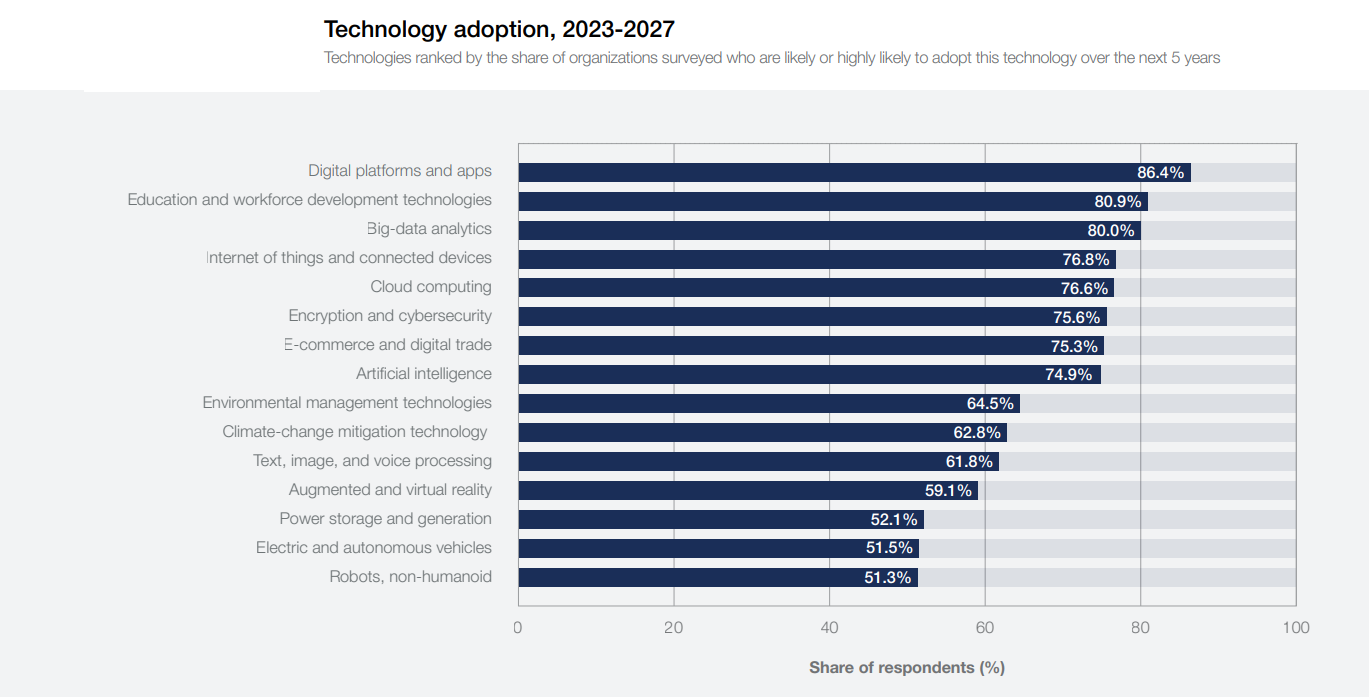
The key skills identified in the report can be found on page 24. The first five of these core areas are covered in the courses offered by the Institute of Business Analytics.