


Management der digitalen Transformation
Overview and learning objectives
In today’s information age, information technology (IT) plays a fundamental role for both society and businesses. The significance of IT has evolved from a purely supportive function to a decisive competitive factor. Despite the great importance attached to IT today, according to a study, on average only 29 per cent of IT projects are completed with satisfactory results and without exceeding budget or deadlines, whilst 19 per cent are abandoned or fail completely (Standish Report 2015). This makes it all the more important to understand and be able to apply the fundamentals and methods of successful IT project management.
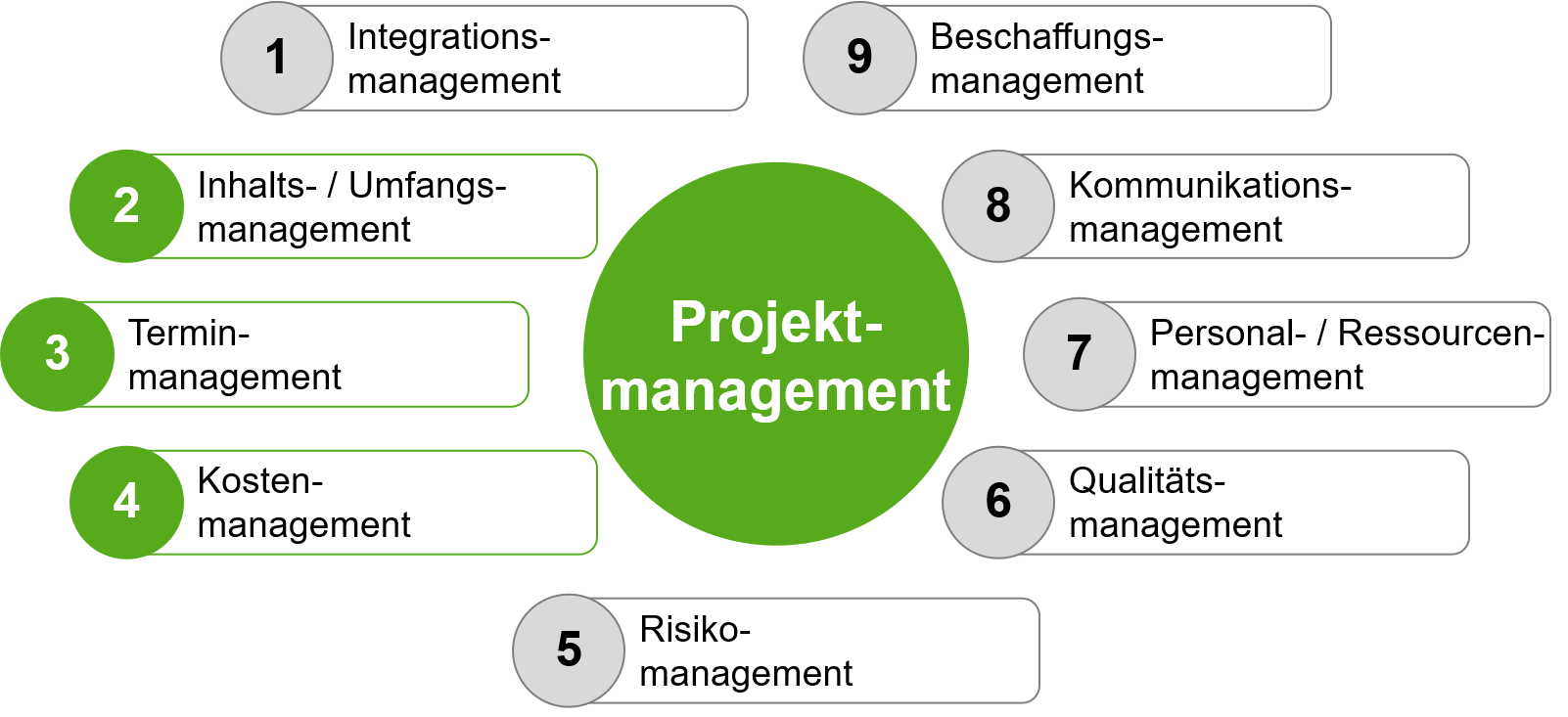
The ‘Management der digitalen Transformation’ module covers the fundamentals and methods required for successful IT project management. The course is structured around three main topics: ‘Fundamentals and Methods of IT Project Management’, ‘Phases and Process Models in IT Project Management’ and ‘Modelling with UML’. Selected areas of IT project management (e.g. integration management, content and scope management, schedule management, cost management, risk management) as well as key methods of IT project management are covered and illustrated using practical examples. In addition, various process models in project management (e.g. Scrum), along with their characteristics and potential applications, are examined. Finally, the “Unified Modelling Language” (UML) (e.g. using use-case and activity diagrams) is used to provide an insight into the predominant modelling language used in IT projects. The course content is rounded off by working on and analysing practical problems using tools (e.g. Microsoft Project or UML Magic Draw) and a practical workshop in collaboration with an industry partner.
Lecturers




Course information
Students who have successfully completed this module
- have studied the three subject areas ‘Fundamentals and Methods of IT Project Management’, ‘Phases and Process Models in IT Project Management’ and ‘Modelling with UML’ in depth and are able to explain them.
- are familiar with selected tasks and methods of IT project management (e.g. integration management, content and scope management, schedule management, cost management and risk management).
- can demonstrate in which project phases and for what objectives IT project management methods are applied, and can evaluate these methods.
- are able to discuss (critically) selected process models in IT project management (e.g. Scrum), as well as their characteristics and potential applications.
- are familiar with the ‘Unified Modelling Language (UML)’, the modelling language predominantly used in IT projects, and can apply it (e.g. use-case and activity diagrams).
- are able to analyse practical problems using selected tools (e.g. Microsoft Project or UML Magic Draw) and derive practical recommendations for action.
This module covers the following technical content:
- Introduction and motivation – IT project management as a highly relevant topic
- Fundamentals and methods of IT project management
- Terms and fundamentals
- Key objectives and areas of responsibility
- Integration management
- Scope and content management
- Schedule management
- Cost management
- Risk management
- Phases and Process Models in IT Project Management
- Phases of IT Project Management
- Software Development Process and Key Activities
- Traditional and Agile Process Models (e.g. Scrum)
- Modelling with UML Activity Diagrams
- Use-Case Diagrams
- Practical workshop (practical presentation, working through a real-world practical problem and deriving recommendations for action)
- Wieczorrek, H. W. und Mertens, P. (2011): Management von IT-Projekten. Springer-Verlag.
- Project Management Institute (2013): A Guide to the Project Management Body of Knowledge. Newtown Square.
Organizational information
Next course start: WiSe 26/27
Dates and place:
Kick off: Tuesday, 13. October 2026, 10 – 12 am (47 -WWP-Lehrgebäude_47.0.501)
Regular Dates: Tuesdays, 10 – 12 am (47 -WWP-Lehrgebäude_47.0.501) & Thursdays, 12 noon – 2 pm (H3)
ECTS: 6
Lecture (2 SWS) with Exercise (2 SWS)
Credit points are awarded on the basis of passing the written module examination. Registration for this examination does not require any prior proof of academic achievement.
The module grade corresponds to the result of the module examination.
Focus: Business Analytics, Technologie- and Prozessmanagement, Unternehmensführung and Controlling, Wahlpflicht BWL
Programs: B.Sc. Wirtschaftswissenschaften, B.Sc. Wirtschaftsmathematik, B.Sc. Wirtschaftschemie, B.Sc. Wirtschaftsphysik and Studiengänge with Nebenfach Wirtschaftswissenschaften