


Customer relationship management and customer analytics
Overview and learning objectives
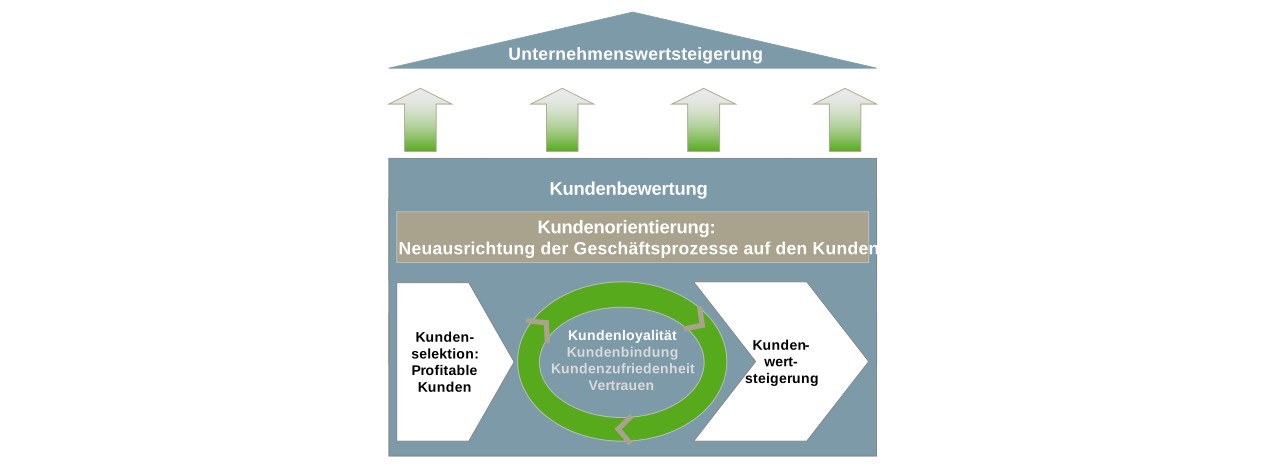
Customer Relationship Management (CRM) is a customer-oriented corporate strategy that uses modern IT to build and consolidate profitable customer relationships in the long term through holistic and individualised marketing, sales and service concepts. CRM techniques are becoming increasingly important for companies, especially in the course of the development from a purely transactional to an individual customer and network-orientated approach. In strategic CRM, for example, the evaluation of individual customer relationships (e.g. on the basis of customer lifetime value) and the value-oriented management of customer portfolios should be mentioned here. In analytical CRM, customer-specific data (e.g. on customer contacts and customer reactions) is recorded, collected, evaluated and analysed using methods such as data mining and text mining (business intelligence). In this way, knowledge about customer structures and customer behaviour is generated in order to support strategic and operational processes.
In the module "Customer Relationship Management and Customer Analytics", central concepts and methods of strategic, operational and analytical CRM are dealt with and illustrated using practical examples.
Students who have successfully completed this module are familiar with the fundamental theoretical principles and methods of CRM. In addition, they are able to successfully solve practical problems with the help of the course content (real use cases are taught in lectures and exercises), interpret the results and derive recommendations for action.
Lecturers



Content information
Students who have successfully completed this module
- are familiar with the key areas and concepts of CRM,
- can evaluate and apply various customer assessment methods,
- can evaluate customer portfolios based on risk/return considerations,
- understand the importance of high-quality data for successful CRM and can apply various metrics to measure data quality,
- can analyse customer data using data analytics methods (e.g. clustering, classification, regression) (also using Python), interpret the results and derive recommendations for CRM.
This module covers the following technical content:
- Customer analytics
- Customer value as a control variable in CRM
- High-quality data as a success factor in CRM
- Data analytics – fundamentals, methods and areas of application in CRM
- Buhl, H. U.; Heinrich, B. (2008) Valuing Customer Portfolios under Risk-Return-Aspects: A Model-based Approach and its Application in the Financial Services Industry. In: Academy of Marketing Science Review 12 (5), S. 1-32.
- Gneiser, M. S. (2010) Wertorientiertes CRM. Das Zusammenspiel der Triadeaus Marketing, Finanzmanagement und IT. In: WIRTSCHAFTSINFORMATIK52 (2), S. 95-104.
- Heyer, G.; Quasthoff, U.; Wittig, T. (2006) Text Mining: Wissensrohstoff Text: Konzepte, Algorithmen, Ergebnisse. W3L-Verlag, Bochum
- Hildebrand, K.; Gebauer, M.; Hinrichs, H.; Mielke, M. (2011) Daten- und Informationsqualität – Auf dem Weg zur Information Excellence. Vieweg +Teubner, Wiesbaden.
- Hippner, H.; Hubrich, B.; Wilde, K.-D. (2011) Grundlagen des CRM: Strategie, Geschäftsprozesse und IT-Unterstützung, Gabler, Wiesbaden.
- Klier, M.; Heidemann, J.; Benno, G. (2010) Die Ermittlung des Kundenpotenzials im Controlling – ein bedarfsorientierter Ansatz und dessen Anwendung bei einem Finanzdienstleister. In: Controlling & Management 54 (1), S. 48-54.
- Linoff, G. S.; Berry, M. J. A. (2011) Data Mining Techniques – For Marketing, Sales and Customer Support, Wiley, Indianapolis
Organisational information
Next event start date: WiSe 26/27
Place: tbd
Dates: tbd
ECTS: 6
Lecture (2 hours per week) with practical (2 hours per week)
Credit points are awarded on the basis of passing the written module examination. Registration for this examination does not require any prior proof of performance.
The module grade corresponds to the result of the module examination.
Main subjects: Schwerpunktfächer Technologie- und Prozessmanagement, Business Analytics, Unternehmensführung und Controlling, Wahlpflicht BWL.
Degree programmes: B.Sc. Wirtschaftswissenschaften, B.Sc. Wirtschaftsmathematik, B.Sc. Wirtschaftschemie, B.Sc. Wirtschaftsphysik und Studiengänge mit Nebenfach Wirtschaftswissenschaften