


Percolation
Connectivity, Criticality and Random Growth
How does local randomness create global connectivity—and a sharp change of phase?
Percolation begins with independent open and closed connections, but quickly leads to deep questions about critical thresholds, planar geometry, infinite clusters and random growth. The seminar develops the central arguments of the theory while keeping the technical scope realistic for a student presentation.
Why percolation?
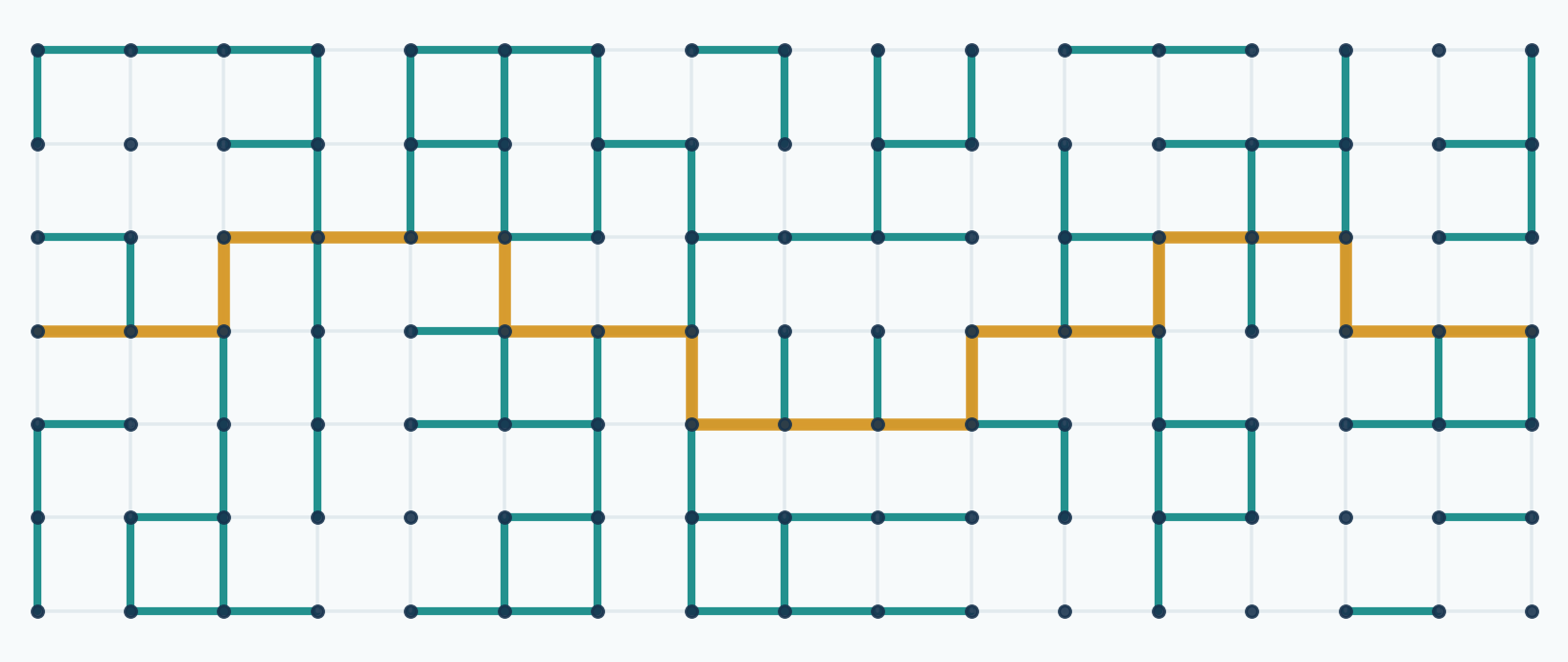
Percolation was introduced to model the passage of a fluid through a porous medium whose channels are randomly blocked. Mathematically, each edge—or each vertex—of a graph is declared open with probability p and closed otherwise. For small p, open clusters are tiny islands; for large p, a connected structure can span the entire system. The abrupt change occurs at a critical value p_c.
This deceptively simple model is now a central meeting point for probability, combinatorics, statistical physics and random geometry. Its ideas illuminate network reliability, transport in disordered materials, epidemic and wildfire spread and wireless connectivity. Its proofs combine elementary probability with genuinely powerful ideas: correlation inequalities, planar duality, crossing estimates, coarse graining and ergodicity. Paths, circuits and random clusters make these ideas visible without making the mathematics superficial.
THE CENTRAL PHENOMENON: A microscopic change in the density of open connections can produce a macroscopic change in connectivity. The seminar studies how this transition is located, how the two phases differ and which geometric tools reveal it.
What students will learn
Phase transition. Work with percolation probabilities, susceptibilities and critical parameters.
Core tools. Use coupling, Harris–FKG association, BK-type bounds and branching-process comparisons.
Planar methods. Apply duality, crossings, circuits and selected RSW estimates.
Two phases. Explain exponential decay, block renormalization and uniqueness of the infinite cluster.
Extensions. Relate Bernoulli percolation to oriented and first-passage percolation.
Communication. Reconstruct a substantial theorem from a textbook chapter and selected original sources.
Suggested seminar format
Audience Master's and Bachelor's students in mathematics or a closely related quantitative field.
Prerequisites A solid first course in probability theory, including conditional expectation and basic convergence results. Elementary graph theory is helpful but will be reviewed.
Format Weekly student presentations of about 75 minutes followed by a guided discussion. Each speaker prepares a concise handout with definitions, the main theorem, proof architecture and one worked application.
Language English. Grimmett's books provide the main route through the material; selected classical papers are optional or used only for focused parts of a presentation.
Contact and Registration
To register for the seminar, please send an email to mikhail.chebunin(at)uni-ulm.de by October 30th, 2026. In your email, include: Your name; Matriculation number; Your program of studies; Relevant coursework in probability, statistics, or signal processing
After the registration deadline, we will schedule an initial meeting to discuss topic preferences and finalize the seminar structure.
Criteria to pass the seminar
Each participant (or group) is required to prepare and present one talk. A written summary of the presentation is also expected. Talks will be held in English, and a preliminary version of the slides must be submitted two weeks before the talk for feedback. Successful completion of these requirements will qualify the participant for passing the seminar.
Seminar topics I
1 Bernoulli percolation and critical parameters
How do we formulate a genuine phase transition in a random graph?
Introduce bond and site percolation, clusters C(x), the percolation function θ(p), susceptibility χ(p) and the critical parameters p_c and p_T. Construct the standard monotone coupling, prove the relevant zero–one law, establish basic relations between the critical parameters and show 0 < p_c(Z^d) < 1 using path counting and a Peierls argument.
Suggested reading: Grimmett [B1], Chapters 1–3; Bollobás–Riordan [B2], Chapter 1.
2 Correlation and comparison inequalities
How can dependent connectivity events be controlled?
Develop increasing events on product spaces and prove the Harris–FKG inequality in the Bernoulli setting. Introduce disjoint occurrence and the van den Berg–Kesten inequality, with a proof in a restricted or finite case. Apply these tools to crossings, multiple connections and simple cluster-size bounds, emphasising when positive and negative correlation estimates arise.
Suggested reading: Grimmett [B1], Chapter 2; Grimmett [B3], Chapter 4; Bollobás–Riordan [B2], Chapter 2.
3 Percolation on trees and branching-process comparison
Why can the phase transition be computed exactly on a regular tree?
Identify the cluster of the root with a Galton–Watson process and determine the critical probability of a regular tree. Calculate the survival probability through the offspring generating function, then use branching-process comparisons to obtain bounds for lattice percolation. Discuss how cycles and geometry make Z^d fundamentally different from a tree.
Suggested reading: Grimmett [B1], Chapters 1 and 3; Grimmett [B3], Chapter 3.
4 Planar duality, crossings and circuits
How does the dual lattice turn connectivity into planar geometry?
Construct the dual configuration on the square lattice and prove the basic primal–dual crossing alternative for rectangles. Introduce open crossings, closed dual circuits and annulus events. Use Harris–FKG to glue crossings and derive a selected Russo–Seymour–Welsh estimate or a carefully stated version sufficient for later topics.
Suggested reading: Grimmett [B1], Chapter 11; Bollobás–Riordan [B2], Chapter 3.
Seminar topics II
5 The Harris–Kesten theorem
Why is the bond-percolation threshold on Z² exactly 1/2?
Prove the Harris lower bound p_c ≥ 1/2 using self-duality and closed dual circuits. Present the Kesten direction through its main sequence of lemmas: crossing estimates, pivotal configurations and enhancement of crossing probabilities. A speaker should prove a substantial selected part rather than reproduce every technical estimate of the full theorem.
Suggested reading: Grimmett [B1], Chapter 11; Bollobás–Riordan [B2], Chapter 3; Kesten [P1].
6 The subcritical phase and exponential decay
How fast do long connections disappear below the critical point?
Study the radius, size and expected size of the cluster containing the origin. Prove exponential decay first in a parameter range accessible by open-path counting, then present the structure of the general subcritical theorem and its relation to p_T=p_c. The most technical differential-inequality steps may be isolated as lemmas rather than proved in full detail.
Suggested reading: Grimmett [B1], Chapters 5–6; Bollobás–Riordan [B2], Chapter 4.
7 The supercritical phase and block renormalization
How do local crossing estimates produce a macroscopic connected backbone?
Partition the lattice into large boxes and define good-block events. Explain how a coarse-grained process can be compared with high-density percolation, and derive a finite-size criterion or a robust crossing statement above p_c. The talk should include one complete block argument and a clear discussion of what renormalization gains and what dependence it introduces.
Suggested reading: Grimmett [B1], Chapters 7–8.
Seminar topics III
8 Uniqueness of the infinite cluster
If percolation occurs, why should there be only one infinite component?
Introduce translation invariance, ergodicity, finite energy and trifurcation points. Present the Burton–Keane argument: several infinite clusters would create too many disjoint exits from large boxes compared with their boundary. The proof is conceptually elegant and should be given in full for Bernoulli percolation on Z^d, with generalisations mentioned only briefly.
Suggested reading: Grimmett [B1], Chapter 8; Bollobás–Riordan [B2], Chapter 5; Burton–Keane [P2].
9 Oriented percolation
What changes when open paths must respect a direction of time?
Define oriented site or bond percolation and its survival probability. Use coupling, path counting and contour arguments to obtain non-trivial bounds on the critical value. Present a basic block construction and explain the link with epidemic growth or the contact process without entering the full theory of interacting particle systems.
Suggested reading: Grimmett [B1], Chapter 12; Bollobás–Riordan [B2], Chapter 4; Durrett [P3].
10 First-passage percolation and the time constant
How does a random environment create an effective large-scale speed?
Assign i.i.d. non-negative passage times to edges and define the minimal travel time T(x,y). Prove the subadditivity relation and use Fekete's lemma to obtain the limit of expected passage times. State Kingman's subadditive ergodic theorem and explain how it yields a deterministic time constant. Conclude with the shape theorem as a carefully motivated statement rather than a full proof.
Suggested reading: Grimmett [B1], Chapters 12–13; Kingman [P4].
Literature
The three books below provide the main exposition. Four classical papers are included for topics where seeing the original theorem is especially valuable; students may use them selectively and are not expected to reconstruct every technical detail.
Core books
[B1] G. Grimmett, Percolation, 2nd ed., Springer, 1999. DOI 10.1007/978-3-662-03981-6
[B2] B. Bollobás and O. Riordan, Percolation, Cambridge University Press, 2006. DOI 10.1017/CBO9781139167383
[B3] G. Grimmett, Probability on Graphs: Random Processes on Graphs and Lattices, 2nd ed., Cambridge University Press, 2018. DOI 10.1017/9781108528986
Selected classical sources
[P1] H. Kesten, “The critical probability of bond percolation on the square lattice equals 1/2,” Commun. Math. Phys. 74 (1980), 41–59. DOI 10.1007/BF01197577
[P2] R. M. Burton and M. Keane, “Density and uniqueness in percolation,” Commun. Math. Phys. 121 (1989), 501–505. DOI 10.1007/BF01217735
[P3] R. Durrett, “Oriented percolation in two dimensions,” Ann. Probab. 12 (1984), 999–1040. DOI 10.1214/aop/1176993140
[P4] J. F. C. Kingman, “The ergodic theory of subadditive stochastic processes,” J. R. Stat. Soc. B 30 (1968), 499–510. DOI 10.1111/j.2517-6161.1968.tb00749.x
Seminar Supervisors
Prof. Dr. Evgeny Spodarev
Helmholtzstraße 18, Raum 1.65
Sprechzeiten: Nach Vereinbarung
E-Mail: Evgeny.Spodarev(at)uni-ulm.de
Dr. Mikhail Chebunin
Helmholtzstraße 18, Raum 1.62
Sprechzeiten: Nach Vereinbarung
E-Mail: Mikhail.Chebunin(at)uni-ulm.de
News
- There will be an organizational meeting with all registiered participants after the registration deadline. Time and date TBA