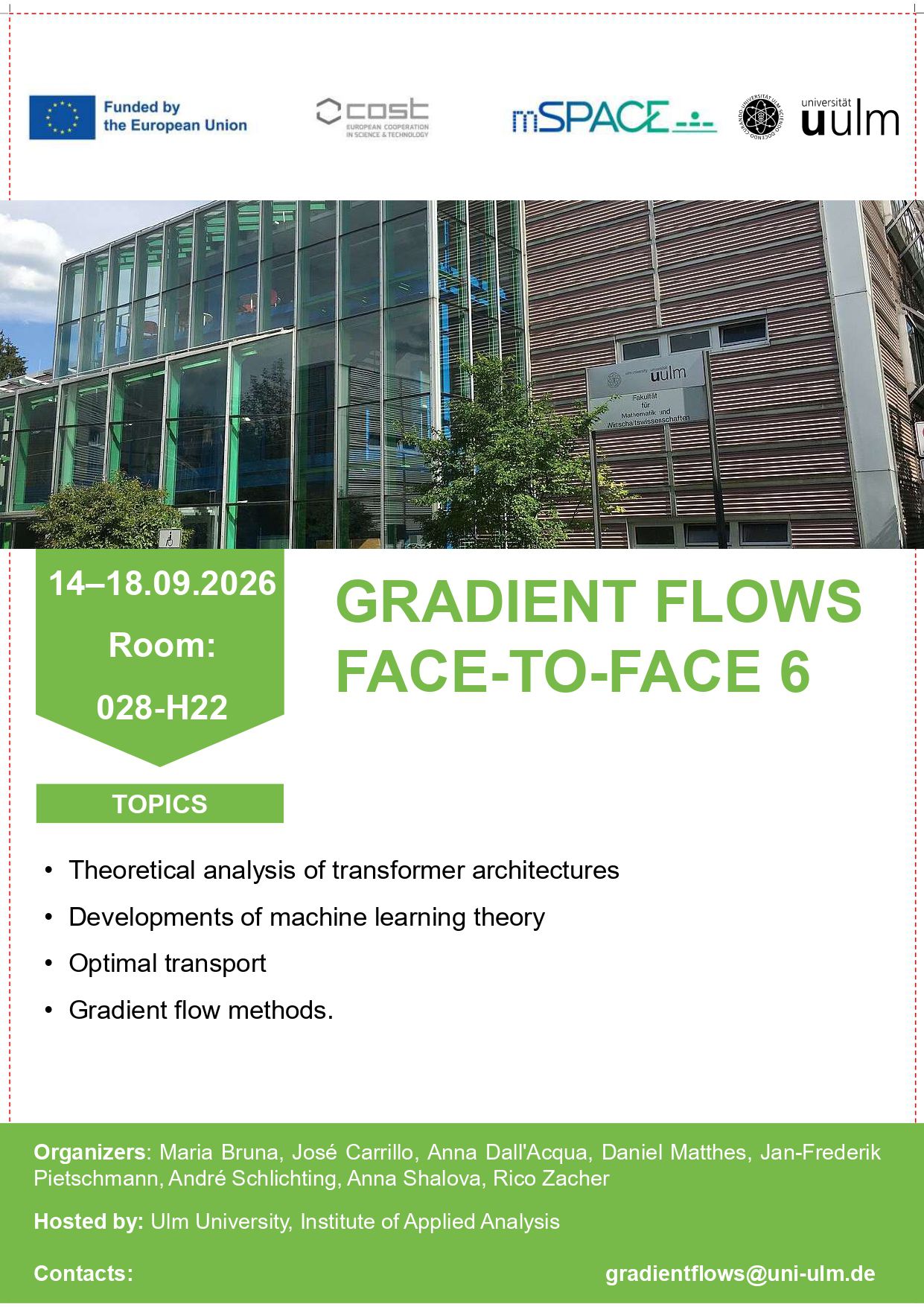
- 14–18 September 2026 at Ulm University
- Wednesday, 16th at 18:30 CONFERENCE DINNER at the vietnamese Restaurant Didi: inside the Xinedome (Am Lederhof 1, 89073 Ulm)
- Organizers: Maria Bruna, José A. Carrillo, Anna Dall'Acqua, Daniel Matthes, Jan-Frederik Pietschmann, André Schlichting, Anna Shalova, Rico Zacher.
This workshop is the sixth edition of the Gradient Flows Face-to-Face series, a recurring meeting born in the aftermath of the pandemic with the aim of bringing together researchers working on gradient flows and related areas. Topics at the heart of the series include interacting particle systems, kinetic theory, variational methods for evolution equations, and optimal transport.
A distinguishing feature of this edition is a dedicated thematic focus on the theoretical analysis of transformer architectures, reflecting the rapid recent developments at the intersection of machine learning theory, optimal transport, and gradient flow methods.
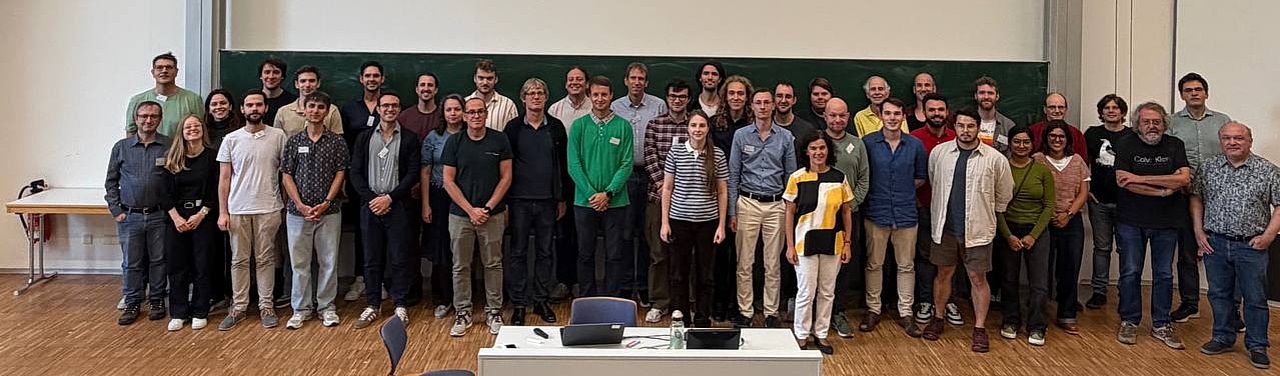
As in previous editions, the workshop is designed to foster a working group atmosphere that prioritizes open discussion and close interaction among participants.
The workshop follows five successful previous editions:
1. Rome
2. L'Aquila
3. Lyon
4. Raitenhaslach (TUM)
5. Granada
How to reach us
The workshop is scheduled to be held in the building's O28 rooms: H20 and H22.
This map shows how to get to the rooms from each tram/bus stop.
“Eingang Süd” is the southern entrance, which is identifiable by the large stairs and the mensa on the left.
Most convenient from the city center is Tram 2 going towards “Science Park” and you get off at “Universität Süd”.
For details you can look here https://ding.eu/ (or the according unser DING app) or SWU Fahrplanauskunft.
It is possible to walk up or down from the city, which has a more or less scenic route. For the scenic route through the botanical garden and along the Wilhelmsburg, I recommend this track (5km 220m uphill) .
A more direct route is 4km with “only” 150m uphill.
Contact
For inquiries, please contact us at gradientflows[at]uni-ulm.de
Registration
Registration is now open! If you're interested, fill our form here
No additional fees are requested.
Schedule
This workshop will takerr place in September from Monday the 14th at 8:30 am to Friday the 18th at 1:00 pm.
Monday | Tuesday | Wednesday | Thursday | Friday | |
|---|---|---|---|---|---|
| 9:00 | Registration | Simone Fagioli | Anna Shalova | Jose M. Mazón | Rishabh Gvalani |
| 9:45 | Anastasiia Hraivoronska | Antonio Esposito | Jasper Hoeksema | Guy Parker | |
10:30 | Coffee | ||||
11:00 | Yann Brenier | Fabian Rupp | Artur Stephan | Gissell Estrada-Rodriguez | Ricardo Guimaraes |
| 11:45 | Hugo Koubbi | Sebastian Hensel | Alejandro Fernández-Jiménez | Jethro Warnett | Markus Schmidtchen |
Gianna Götzmann | |||||
12:30 | Lunch | ||||
14:00 | Andrea Agazzi | Katharina Hopf | Matthias Liero | Nadia Ansini |
|
14:45 | Tim Roith | Juliane Krautz | Holger Spellmann | Moritz Gau | |
Fabian Merz | Christian Amend | Fanch Coudreuse | |||
15:30 | Coffee | ||||
16:00 | Open problem session | Pitches Posters Discussion | Social programm/ Discussion | Discussion |
|
17:30 | Reception |
|
| ||
| 18:30 | Dinner Didi Restaurant | ||||
Abstracts
Abstract: In this talk, we study the evolution of tokens across the depth of encoder-only transformer models at inference time, modeling them as a system of interacting particles in the infinite-depth limit. Motivated by techniques for extending the context length of large language models, we focus on the moderate interaction regime, where the number of tokens is large and the inverse temperature parameter scales accordingly. In this setting, the dynamics exhibit a multiscale structure. Using PDE analysis, we identify different phases depending on the choice of parameters.
Abstract: One of the most popular approaches for TV-regularized optimization problems in the space of measures is the so-called Particle Gradient Flow. For this, one restricts to linear combinations of Dirac deltas and then takes a Euclidean gradient flow in the weights and positions, significantly simplifying computations. Recent results have shown that PGFs recover Wasserstein gradient flow dynamics, and can even converge to global minima under sufficient conditions.
In this talk, I present a generalization of PGFs to regularized optimization problems on arbitrary Banach spaces, which we call Atomic Gradient Flow (AGF). The crucial idea is the choice of the right notion of particles, which we argue to be the extremal points of the unit ball of the regularizer. Using Choquet's theorem, we lift the problem into the Wasserstein space of both weights and extremal points, and study convexity, existence, and uniqueness properties for the AGF and metric gradient flows in the lifted setting. Our main result is then that the lifting of the AGF is again a metric gradient flow in the Wasserstein space, implying that the AGF follows a very strong dynamic.
This is joint work with Marcello Carioni and Konstantinos Zemas.
Abstract: We study a nonlocal model for thin films via Γ-convergence.
We consider convolution-type functionals depending on two parameters: γ, representing the thickness of the domain, and ε, the interaction horizon.
The main result is a compactness and integral representation theorem showing that the Γ-limits are local integral functionals defined on Sobolev spaces.
This result is applied to derive periodic homogenization results. A multiscale analysis highlights that the dimension-reduction phenomenon depends on the mutual vanishing behavior of the two parameters ε and γ as they tend to zero.
This is a joint work with Antonio Tribuzio (University of Bonn).
Abstract: Motivated by continuum self-attention dynamics, we discuss a model of collective diffusion of particles and a related optimal control problem: Find a divergence-free field of symmetric diffusion matrices, that drives all the particles from their given initial to final positions, of minimal cost. This problem is not convex and we propose a convex relaxation as well as a gradient flow to reach the optimal value.
Jointly with Borjan Geshkovski
Abstract: The regularity theory of the porous-medium equation is shaped by its nonlinear and degenerate diffusion: solutions need not be smooth, even for positive times. Although Hölder continuity is classical, quantitative regularization estimates analogous to those available for the heat equation remain less well understood.
Recently, N. David and F. Santambrogio proved that, for a suitable range of the diffusion exponent $m$, a power of the solution satisfies an explicit spatial Lipschitz bound. Their approach relies on a Bernstein type method and known quantitative $L^\infty$-estimates on the solution, relying on the Aronson-Bénilan estimate. In this talk, I will present an extension of this approach to quantitative Hölder estimates in certain parameter regimes, using a two points version of the Bernstein method adapted to the Hölder semi-norm.
This is ongoing joint work with F. Santambrogio.
Abstract: The aggregation equation arises naturally in kinetic theory in the study of granular media, and its interpretation as a 2-Wasserstein gradient flow for the nonlocal interaction energy is well-known. Starting from the spatially homogeneous inelastic Boltzmann equation, a formal Taylor expansion reveals a link between this equation and the aggregation equation with an appropriately chosen interaction potential. Inspired by this formal link and the fact that the associated aggregation equation also dissipates the kinetic energy, I shall present a novel way of interpreting the aggregation equation as a gradient flow, in the sense of curves of maximal slope, of the kinetic energy, rather than the usual interaction energy, with respect to an appropriately constructed transportation metric on the space of probability measures. The seminar is based on a joint work with R. S. Gvalani (Edinburgh), A. Schlichting (Ulm), M. Schmidtchen (Dresden).
Abstract: We propose a Lagrangian-type scheme for the compressible Euler equations with friction, designed specifically to overcome the absence of classical Hamiltonian or gradient flow structures in the underlying dissipative dynamics. Inspired by the results in [2], our approach is driven by the system's variational properties and its structural relaxation toward the porous medium equation in the high-friction limit. To effectively capture these phenomena, we introduce a time-discrete framework that freezes the friction-induced scaling profiles within each step. We then regularize the fluid’s internal energy via a Moreau-Yosida approximation in the $L^2$ framework, formulating the spatial problem as a semi-discrete optimal transport problem. Finally, through a modulated energy functional, we establish rigorous convergence estimates that directly recover smooth solutions to the limiting porous medium equation.
In turn, our result rigorously justifies the equation solved by the flow map of the Euler equations with friction, as an approximation of the one for the limit, when the relaxation parameter, together with and time-step and the partition of the initial support vanishes. This is a joint work with C. Lattanzio (University of L’Aquila) [1].
[1] Fagioli, S. & Lattanzio, C. (2026) Lagrangian discretization for Euler fluids with friction and diffusive relaxation limit, work in preparation.
[2] Gallouët, T. O., Mérigot, Q., & Natale, A. (2022). Convergence of a Lagrangian Discretization for Barotropic Fluids and Porous Media Flow. SIAM Journal on Mathematical Analysis, 54(3), 2990-3018. https://doi.org/10.1137/21M1422756

Abstract: Cell–cell adhesion drives collective behaviours such as segregation, mixing, and invasion, but the underlying interaction parameters are not directly observable. We develop a Bayesian framework that infers these parameters from partial cell trajectories by linking microscopic stochastic dynamics with macroscopic population densities. The resulting likelihood enables estimation of adhesion strengths, repulsion radii, and nonlinear diffusion coefficients, with uncertainty quantified through preconditioned Crank–Nicolson MCMC sampling. We validate the method for one population and then estimate six parameters for two interacting populations across four distinct dynamical regimes. Experiments with synthetic trajectories show accurate recovery of the main parameters, reduced uncertainty with additional trajectories, and robustness to MCMC tuning and initialisation. The framework provides a basis for inferring quantitative intteraction laws from experimental cell-trajectory data.
Abstract: Viscoelastic phase separation occurs in binary fluids where the constituent molecules aggregate on strongly different time scales. Typical morphological features of this process are volume shrinking, sponge-like structures and phase inversion. Such phenomena are observed, for instance, in polymer solutions, where polymer chains are much larger and migrate much more slowly compared to solvent molecules.
In this talk, we consider a diffuse-interface model as proposed by Zhou, Zhang and E (2006). The model couples a Cahn–Hilliard equation with degenerate mobility to the spherical part of the bulk stress, which itself is governed by relaxation dynamics. Our main objective is to show that approximate solutions constructed via an adapted JKO scheme involving a Benamou-Brenier type metric converge to weak solutions satisfying the energy-dissipation inequality. The proof relies on the flow interchange technique and on suitable interpolants for the flux.
This work is part of a joint project with Katharina Hopf (WIAS) and Matthias Liero (WIAS).
Perturbed Minimizing Movements of Time-Dependent Functionals on Metric Spaces
Minimizing movement schemes are a fundamental tool for approximating evolution equations that have a gradient-flow structure with respect to an energy. Motivated by homogenization problems involving, for instance, geometries that evolve in time, we consider Γ-converging perturbations of time-dependent driving energies. We study the convergence of the corresponding minimizing movement scheme and provide sufficient conditions under which limits of the scheme are (time-dependent) curves of maximal slope for the limit energy. We further exhibit examples showing that, in general, such a stability property may fail, with the limit motion depending on the relation between the time-discretization parameter τ and the perturbation parameter ε.
This is joint work with Jan-Frederik Pietschmann and Antonio Tribuzio.
Abstract: Nonlocal porous-medium type equations arise naturally in the study of aggregation, diffusion, and collective dynamics. In this talk, I will discuss a class of models driven by anisotropic repulsive interactions and external confinement. The equation has a natural Wasserstein gradient-flow structure, but the anisotropy of the interaction creates new challenges in the analysis of solutions and equilibrium states.
I will present recent results on the construction of global weak solutions through a minimizing-movement scheme and the derivation of energy-dissipation inequalities. The talk will also address uniqueness of steady states among bounded continuous probability densities, uniform (L^p), (L^\infty), and Hölder estimates, and the convergence of solutions toward the unique equilibrium measure in local Hölder norms.
Abstract: We study the ergodic behaviour of the McKean-Vlasov equations driven by common, divergence-free transport noise. In particular, we show that in dimension d≥2, if the noise is white-in-time, mixing, and sufficiently strong it can enforce the uniqueness of invariant probability measures, even if the deterministic gradient flow has multiple steady states. Time permitting, we will also discuss analogous results when the driving velocity field comes from the stationary 2D Navier--Stokes equations with additive noise satisfying the Hairer-Mattingly non-degeneracy conditions. This is joint work with Benjamin Gess (Berlin/Leipzig) and Adrian Martini (Berlin).
Abstract: I discuss a novel gradient-flow approach to derive a quantitative form of the classical isoperimetric inquality, which in particular implies all previously known versions. The argument is based solely upon a notion of "gradient-flow calibrations" from which one may derive a modulated entropy-entropy dissipation structure. If modulated entropy is measured against (dynamic modulations of) the unit ball, this structure can be used to derive a quantitative decay estimate for modulated entropy of sufficiently well-behaved weak solutions of either volume-preserving mean curvature flow or Mullins-Sekerka flow for perturbative initial data. This decay estimate in turn essentially implies the quantitative isoperimetric inequality, and it does not use Łojasiewicz-Simon estimates. It represents the flow-based version of my recent static calibration argument for the quantitative isoperimetric inequality (joint work with Tim Laux, arXiv:2606.17172). This is work in progress with Tim Laux and Andrea Poiatti.
Abstract: We analyse the JKO scheme for Dirichlet-type energies in fibered optimal transport. Our main interest concerns the variational mechanisms underlying energy dissipation and convergence. If time permits, we also discuss extensions to non-diagonal gradient energies and evolving fibre marginals. Our study is motivated by applications in molecular biology.
Abstract: Systems of coalescing particles might lead, in the hydrodynamic limit, to a mean-field equation at the level of cluster densities, such as the Exchange-Driven Growth equation. The latter can be seen as a baby version of the usual Boltzmann equation and conserves the first moment. In this talk, we discuss convergence of the corresponding Kac model at the level of evolutionary Gamma-convergence of the associated generalized gradient-flow structures. Special care will be needed to deal with the possible loss of moments in the limit, leading to condensation, which can be represented by the formation of clusters with infinitely many particles.
This is based on joint work with André Schlichting and Chun Yin Lam.
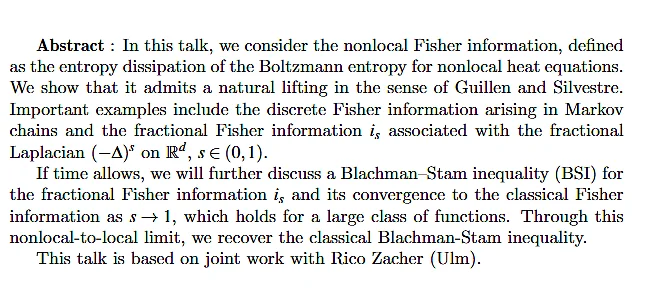
Abstract: We introduce a fully discrete variational scheme for Otto gradient flows, obtained by restricting the measures in the JKO scheme to be supported on a regular grid. In particular, this provides a natural structure-preserving discretization for macroscopic crowd dynamics. We discuss convergence as the spatial and temporal discretizations vanish in a suitable regime. Finally, we show numerical simulations.
Abstract: The Schrödinger problem admits a strong connection to optimal transport, which is well-established on spaces satisfying synthetic lower curvature bounds. We study this connection on metric graphs, which are prototypical examples where such bounds fail.
Starting from a static version of the Schrödinger problem, we introduce an equivalent reformulation as entropic optimal transport and prove $\Gamma$-convergence towards static optimal transport.
We then derive a Benamou-Brenier type dynamic version of the Schrödinger problem. Using this equivalence, we conclude that the minimum values of the dynamic Schrödinger problem converge towards the squared Wasserstein distance, and that minimizers converge to Wasserstein geodesics.
This talk is based on joint work with Jan-Frederik Pietschmann.
Abstract: We study a random model of deep multi-head self-attention in which the weights are resampled independently across layers and heads, as at initialization of training. Viewing depth as a time variable, the residual stream defines a discrete-time interacting particle system on the unit sphere. We prove that, under suitable joint scalings of the depth, the residual step size, and the number of heads, this dynamics admits a nontrivial homogenized limit. Depending on the scaling, the limit is either deterministic or stochastic with common noise; in the mean-field regime, the latter leads to a stochastic nonlinear Fokker--Planck equation for the conditional law of a representative token. In the Gaussian setting, the limiting drift vanishes, making the homogenized dynamics explicit enough to study representation collapse. This yields quantitative trade-offs between dimension, context length, and temperature, and identifies regimes in which clustering can be mitigated.
Abstract: Since their introduction in 2017, Transformers have profoundly reshaped large language models and, more broadly, deep learning. This success largely hinges on the so-called "self-attention" mechanism. In this talk, I will first review a mathematical framework that interprets self-attention as a system of interacting particles. I will explain some remarkable properties of the associated dynamics in the space of probability measures, with a particular focus on cluster formation, gradient flows, the preservation of Gaussian distributions, the subtleties of the associated mean-field limit, and the high expressivity of these neural networks. Then, I will try to highlight new directions in the study of Transformers from a mathematical standpoint.
Abstract: Rough path theory offers a robust framework for the study of complex stochastic systems, with applications ranging from stochastic analysis and quantitative finance to machine learning. Its natural geometric setting is provided by Carnot groups, which encode the intrinsic stratified and non-commutative structure of rough paths.
In this talk, we consider optimal transport problems on spaces of paths taking values in a Carnot group. We introduce a variational construction of a natural transport cost in this setting and show that it can be obtained as the Γ-limit of a family of discrete transport problems. This establishes a rigorous link between the geometry underlying rough paths and variational methods in optimal transport.
This is joint work with Peter K. Friz (TU Berlin and WIAS), Helena Kremp (TU Berlin and WIAS), Vaios Laschos (kausable.ai), and Benjamin A. Robinson (University of Klagenfurt).
Abstract:
Abstract: When two densities diffuse along a common pressure which depends only on their sum, species segregation persists across time and sharp interfaces are transported along the flow. However, if each density is also transported by an independent potential drift, this property can not be guaranteed.Here, I will present recent work showing that the persistence or
breakdown of an inter-species interface instead depends on the chosen notion of solution. When the drifts push the two phases towards each other, the vanishing-viscosity solution creates an overlap, whereas a segregated weak solution also exists. Our analysis follows the careful study of a new relative entropy variable which can measure the mixing of the two species.
The talk will be based on joint work with Charles Elbar.
Abstract: Transformer architectures have driven recent breakthroughs in natural language processing, computer vision and generative modeling. Their increasing empirical success calls for a thorough understanding of their inner mechanisms for ensuring their reliable and secure deployment. A recent work by Geshkovski, Letrouit, Polyanskiy and Rigollet systemized the mathematical framework for analyzing the forward pass of a transformer by interpreting it as a system of interacting particles, namely the so-called tokens in the architecture. This perspective allows for many interesting connections, such as the study of the associated partial differential equation, which can give (at least partially) an answer to the long-term behavior of the system. In this talk, we give an introduction into the topic and highlight the driving questions such as clustering and meta-stability. Moreover, we will present results from Burger, Kabri, Korolev, R and Weigand, which consider self-attention on a sphere, motivated by normalization layers in a transformer architecture. Under some assumptions on the weight matrices, the long-time behavior is given as the solution of an energy minimization problem over measures on the sphere. We show how minimizers can be characterized depending on the eigenvalues of the weight matrices. Beyond that, we will highlight a strong connection between transformer dynamics and consensus-based optimization, which allows to study the dynamics beyond the gradient flow setting. Building on recent work by Bruno, Pasqualotto and Agazzi, we present a quantitative estimate for the low-temperature limit from Alcalde, Bungert, Riedl and R.
Abstract: Mean curvature flow is classically understood as the L2-gradient flow of the volume functional. In the non-compact setting, however, this variational interpretation degenerates, since the volume is infinite and the associated energy identity becomes vacuous. In this talk, I will present a new calibration energy that measures the deficit of a submanifold from calibrated geometry. Our main result is an exact energy dissipation identity along mean curvature flow. Unlike volume, our calibration energy can remain finite for non-compact submanifolds, and thus provides a novel variational framework for mean curvature flow beyond the compact setting. If time allows, we will also discuss applications. This is joint work with T. Miura (Kyoto).
Abstract: We derive a macroscopic cross-diffusion model for two species of Brownian particles interacting through short-range repulsive potentials. Starting from an overdamped stochastic particle system, we use matched asymptotic expansions to close the associated Fokker–Planck hierarchy in the dilute interaction regime. The resulting continuum equations retain local pair correlations that are lost in a conventional mean-field closure.
For weak regular potentials, the model reduces to the familiar localised mean-field system. For singular inverse power-law interactions, however, additional cross-crowding terms arise that decrease the effective self-diffusion of one species in the presence of the other. These terms are relevant to crowded heterogeneous populations and cannot be recovered by first taking a mean-field limit and subsequently localising the interaction kernel.
(joint work with M. Bruna, M. Burger, C. Keller)
Abstract: We introduce the Random Quadratic Form (RQF): a stochastic differential equation which formally corresponds to the gradient flow of a random quadratic functional on a sphere with white in time coefficients. While the one-point dynamics of the system is a Brownian motion and thus has no preferred direction, the two-point motion exhibits nontrivial synchronizing behaviour. We use the Random Dynamical Systems framework to show how the properties of the deterministic gradient flow translate into the random setting. In particular, we show that the random attractor of the RQF inherits the structure of the minimisers of its deterministic counterpart. We then consider the RQF model perturbed by a random independent forcing and recover the resulting multi-scale synchronising behaviour which illustrates the 'metastable synchronisation by noise' phenomenon.
Abstract: Using the example of reversible Michaelis-Menten kinetics, we show how the introduction of scalings in the reaction rate equation of chemical reaction networks leads to new generalized gradient system structures which arise as EDP-limits. They provide a thermodynamical interpretation to kinetics beyond mass-action kinetics.
Abstract: We provide a derivation of the fourth-order DLSS equation based on an interpretation as a chemical reaction network. We consider on the discretized circle the rate equation for the process where pairs of particles sitting on the same site jump simultaneously to the two neighboring sites, and the reverse jump where a pair of particles sitting on a common site jump simultaneously to the site in the middle. Depending on the reaction rates, in the vanishing mesh size limit we obtain either the classical DLSS equation or a variant with nonlinear mobility of power type. We identify the limiting gradient structure to be driven by entropy with respect to a generalization of diffusive transport with nonlinear mobility via evolutionary convergence for gradient systems. Furthermore, the DLSS equation with nonlinear mobility of the power type shares qualitative similarities with the fast diffusion and porous medium equations, since we find traveling wave solutions with algebraic tails and polynomial compact support, respectively.
The talk is based on joint work with Alexander Mielke (Berlin) and André Schlichting (Ulm).
Abstract: Stein Variational Gradient Descent (SVGD) is a widely used in practice algorithm for scalable sampling with deterministic particle updates. We study its behavior in the singular limit where the kernel bandwidth tends to zero. In this regime, we show that the nonlocal SVGD dynamics converge to a local evolution equation that can be formally interpreted as a Wasserstein gradient flow with quadratic mobility. We analyze this singular limit in two settings: integrable kernels and weighted kernels. In the weighted case, the proof is supported by recently established Stein-log-Sobolev inequalities, which provide the necessary functional control. Overall, our results clarify how SVGD collapses from a nonlocal interacting particle system to a local gradient-flow dynamics as the kernel concentrates.
Participant List
Andrea Agazzi (Bern)
Christian Amend (University of Twente)
Nadia Ansini (Rome)
Yann Brenier (Paris)
Maria Bruna (Oxford)
Clément Cancès (Lille)
José Carrillo (Oxford)
Sofiane Cherf (Camille Jordan)
David Cohen (CCS)
Fanch Coudreuse (Camille Jordan)
Francesca Costantini (L'Aquila)
Anna Dall’Acqua (Ulm)
Bertram Düring (Warwick)
Tom ter Elst (Auckland)
Antonio Esposito (Oxford)
Gissell Estrada-Rodriguez (Catalunya)
Simone Fagioli (L’Aquila)
Alejandro Fernandez-Jimenez (Oxford)
Moritz Gau (WIAS Berlin)
Nicolai Gerber (Ulm)
Gianna Götzmann (Augsburg)
Ricardo Guimarães (Oxford)
Rishabh Gvalani (ETH Zürich)
Georg Heinze (WIAS Berlin)
Sebastian Hensel (Leipzig)
Jasper Hoeksema (Eindhoven)
Katharina Hopf (WIAS Berlin)
Anastasiia Hraivoronska (ICJ Lyon)
Daniel Kelly (Oxford)
Juliane Krautz (Augsburg)
Hugo Koubbi (Paris Dauphine- PSL)
Anna Maria Kolb (Ulm)
Philippe Laurençot (CNRS & Mont Blanc)
Cyril Letrouit (Paris Saclay)
Matthias Liero (WIAS Berlin)
Kexin Lin (Institut Camille Jordan)
Jan Maas (ISTA)
Daniel Matthes (TUM)
Jose M. Mazón (Valencia)
Fabian Merz (Ulm)
Delio Mugnolo (Hagen)
Guy Parker (Lyon)
Jan-Frederik Pietschmann (Augsburg)
Lorenzo Portinale (Milano)
Christoph Richter (Leipzig)
Tim Roith (DESY/Munich)
Domènec Ruiz-Balet (Barcelona)
Fabian Rupp (Uni Wien)
Manfred Sauter (Ulm)
André Schlichting (Ulm)
Adrian Schmautz (Ulm)
Markus Schmidtchen (Dresden)
Holger Spellmann (Ulm)
Artur Stephan (TU Wien)
Sebastian Throm (Umea)
Joop Vermeulen (Eindhoven)
Jethro Warnett (Oxford)
Andrew Warren (Utrecht University)
Stephen J. Watson (Glasgow)
Nicola Zamponi (Augsburg)
Rico Zacher (Ulm)
Johannes Zimmer (TU München)
This workshop is partially funded by the Advanced Grant Nonlocal-CPD: "Nonlocal PDEs for Complex Particle Dynamics: Phase Transitions, Patterns and Synchronization" of the European Research Council Executive Agency (ERC) under the European Union's Horizon 2020 research and innovation programme (grant agreement No. 883363).