ULMA Economic Workshop

Welcome to the ULMA Economic Workshop!

The ULMA Economic Workshop (ULMA-EW) is an international, research-oriented teaching format delivered by the Institute of Economics at Ulm University. It extends the ULMA Economic Olympiad and connects selected international participants with Ulm students in the master seminar Applied Data Science: Replication & Extension.

The ULMA-EW is open to suitable universities worldwide. No existing partnership or previous cooperation with Ulm University is required. While lecturers from Ulm University provide the teaching and academic guidance, your university hosts the Three-Day On-Site Training locally. 

After the application phase has ended, three partner universities will be selected from all applicant universities to participate in the ULMA Economic Workshop.

At a Glance

  • Application deadline: 30 June 2026
  • Costs: Free of charge
  • Who applies: Universities apply and nominate 4 to 6 Master's students.
  • Who teaches: Lecturers from the Institute of Economics at Ulm University deliver the Three-Day On-Site Training.
  • Who hosts: Selected universities provide the local room, internet access, presentation equipment, and local coordination.
  • Academic focus: Replication of published empirical studies in economics.
  • Working language: English.

What the ULMA-EW Is About

Each student team works on one published empirical study. The aim is to reproduce main results, document deviations, conduct robustness checks where feasible, and prepare a transparent replication package. This is a meaningful contribution to the quality assurance of empirical economic research, not merely a classroom exercise.

International participants collaborate with students from Ulm University enrolled in the master seminar Applied Data Science: Replication & Extension. The project combines empirical economics, reproducible workflows, international collaboration, and the critical use of AI agents as research assistants.

How the Program Works

  1. Invitation and applications: 20 May to 30 June 2026. Universities submit the application and nominate 4 to 6 students.
  2. Review and selection: 1 to 15 July 2026. Selection takes place at university level.
  3. Onboarding and setup: 16 July to 2 August 2026. Selected universities confirm local coordination, room, internet access, and tool setup.
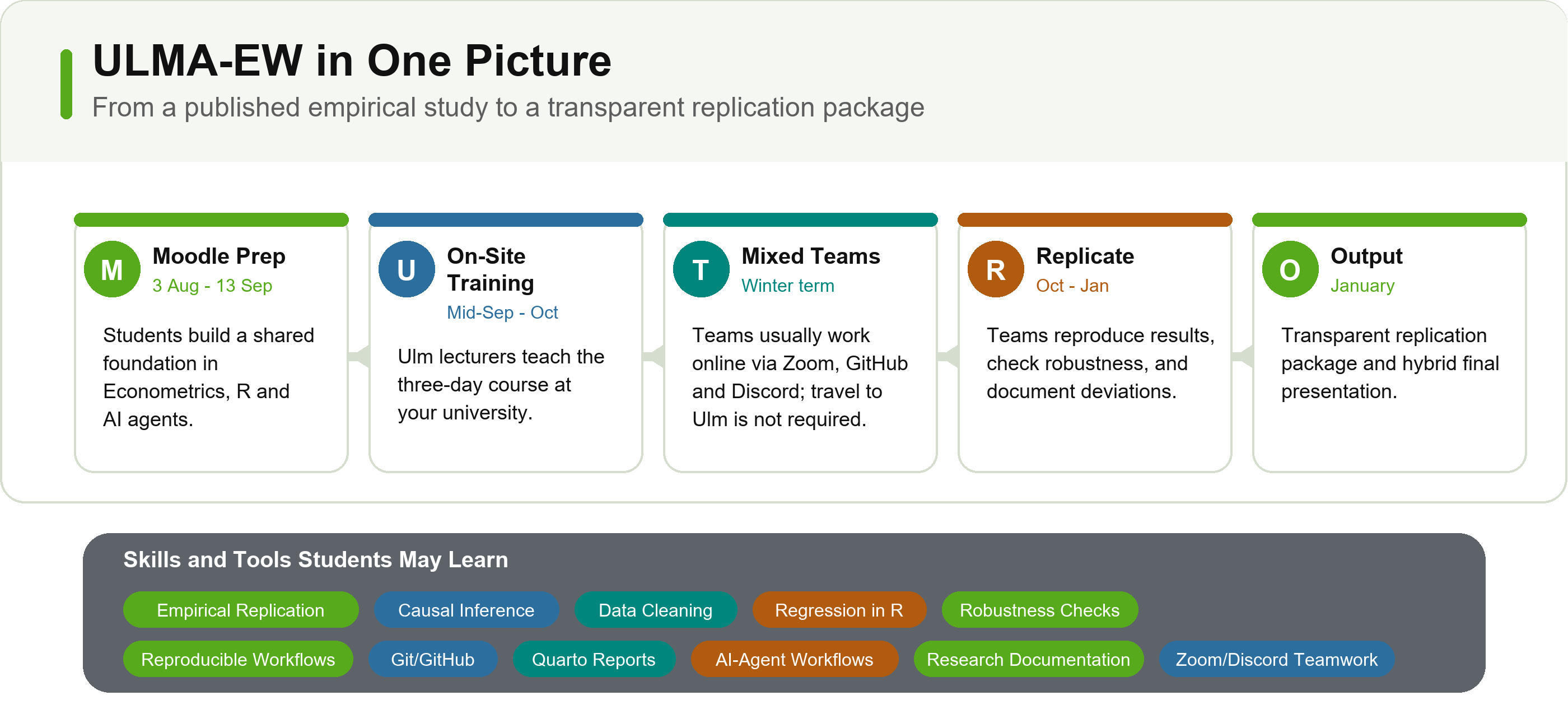
  4. Moodle preparation: 3 August to 13 September 2026. Students prepare independently with materials provided by Ulm University.
  5. Three-Day On-Site Training: 14 September to 30 October 2026. Ulm lecturers deliver the training locally at the selected host university.
  6. Hybrid research phase: October 2026 to January 2027. International participants and participants from Ulm University form teams and collaborate in replication projects.
  7. Final presentations: January 2027. Teams present their replication results in English in a hybrid Zoom session.

Tools and AI Agents

Preparation materials are provided via Moodle. During the on-site training and hybrid research phase, students use industry-standard collaboration and research tools such as GitHub, Zoom, Discord, R, and Quarto. Python may be used where appropriate.

AI agents are used as research assistants for longer, multi-step workflows. Unlike a regular AI chat, agents can help inspect code, work with data, run or revise scripts, debug errors, compare outputs with published tables, document decisions, and support reproducible reporting. Students learn to use these tools critically and transparently, not as replacements for their own reasoning.

Application and Required Documents

Applicant universities must submit one ZIP archive containing the completed application form and all required attachments. Applications cannot be considered if required documents are missing, the form is incomplete, or information is incorrect.

  • Completed partner university application form
  • English module handbooks or course catalogues for all study programs represented by the nominated students
  • Transcripts of records for each nominated student
Overview
 
Target Group

Students in Economics or comparable courses (M) 

Cycle

Every year in the Winter term

Dates

Application via University until:
30.06.2026 | 23:59 (CET)
Collaborative research phase:
Winter Semester 2026/27

Location
Locally and internationally online via Moodle

Application Form for the ULMA Economic Workshop

  • Bitte erlauben Sie Cookies in Ihrem Browser
Application


Die im Formular von Ihnen angegebenen Daten werden von uns ausschließlich für die Beantwortung bzw. Umsetzung Ihrer Anfrage und zur Kontaktaufnahme verarbeitet. Für die Verarbeitung beziehen wir uns auf den Art. 6. Abs. 1 lit. a DSGVO, sofern keine anderweitige gesetzliche Grundlage besteht. Eine Weitergabe an Dritte findet grundsätzlich nicht statt. Sie können Ihre erteilte Einwilligung jederzeit mit Wirkung für die Zukunft widerrufen. Im Falle des Widerrufs werden Ihre Daten umgehend gelöscht. Ihre Daten werden ansonsten gelöscht, wenn wir Ihre Anfrage bearbeitet haben oder der Zweck der Speicherung entfallen ist. Sie können sich jederzeit über die zu Ihrer Person gespeicherten Daten informieren. Weitere Informationen zum Datenschutz finden Sie auch in der Datenschutzerklärung dieser Webseite.

FAQs

No. Participation in the ULMA Economic Workshop is free of charge. The on-site workshop is organized and delivered by the ULMA team, and no travel to Ulm is required for participating students, as the workshop takes place directly at the partner institution.

The ULMA-EW is designed for Master's students from universities selected to host the Three-Day On-Site Training. The training is delivered by lecturers from the Institute of Economics at Ulm University. It is especially suitable for students in economics, finance, data science, business analytics, or related quantitative study programs with an interest in empirical research.

No. Universities do not need to have an existing partnership or previous cooperation with Ulm University. Any suitable university can apply to participate in the ULMA-EW, host the Three-Day On-Site Training locally, and nominate students.

No. Individual students cannot apply directly to Ulm University. Applications are submitted by universities, and each applicant university nominates 4 to 6 students. Students who are interested in participating should contact their department, program coordinator, or local contact person to find out whether their university is applying.

Selection takes place at applicant-university level. This means that either all nominated students from a selected university are accepted, or the university is not selected for the current round.

Universities first apply and nominate 4 to 6 students. After selection, students receive access to the preparation materials via Moodle from 3 August to 13 September 2026. The Three-Day On-Site Training takes place locally at the selected host university between mid-September and October and is delivered by lecturers from Ulm University. After the training, the hybrid research phase begins: international participants work with Ulm students in the seminar "Applied Data Science: Replication & Extension" and collaborate on replication studies during the semester.

Selected students prepare independently from 3 August to 13 September 2026 before the Three-Day On-Site Training using learning materials provided by the Institute of Economics at Ulm University via Moodle. The preparation helps participants build a common foundation in empirical research, reproducible workflows, and the tools used during the training.

Lecturers from Ulm University visit the selected host university and deliver a Three-Day On-Site Training between mid-September and October. The training introduces students to causal inference, regression analysis in R, reproducible research workflows, replication studies, and the use of AI agents in empirical economic research.

After the on-site training, international participants collaborate with students from Ulm University enrolled in the master seminar "Applied Data Science: Replication & Extension". In international teams, they work on the replication of existing published empirical studies and continue the project in a hybrid format during the semester.

Each team works on one published empirical study. The team reproduces the main results, documents deviations, performs robustness checks, and may develop a meaningful extension. The goal is to create a transparent and reproducible replication package.

Replication studies contribute to the quality assurance of empirical economic research. They test whether published findings can be reproduced, how robust the results are, and whether the research workflow is transparent and well documented. Participants therefore work on a meaningful research task rather than a purely artificial classroom exercise.

AI agents are used as research tools, for example for literature review, code understanding, data preparation, debugging, documentation, and empirical analysis. Students learn to use these tools critically and transparently as part of a reproducible research workflow.

A regular AI chat mainly answers individual prompts in a conversation. AI agents can support longer, multi-step research workflows: they help inspect code, work with data, run or revise scripts, debug errors, document decisions, and coordinate tasks within a replication project. In the ULMA-EW, students learn to use AI agents critically and transparently as research assistants, not as replacements for their own reasoning.

Preparation materials are provided via Moodle. During the on-site training and hybrid research phase, students use industry-standard collaboration and research tools such as GitHub, Zoom, Discord, R, Quarto, and AI-based coding and research assistants. Python may be used for selected tasks where appropriate.

Credit recognition depends on the home university. Applicant universities are asked to indicate whether credits or formal recognition can be awarded for participation.

The on-site training, collaboration, documentation, and final presentations are conducted in English.

Selected host universities nominate 4 to 6 suitable students, support local coordination, and provide suitable seminar rooms, reliable internet access, presentation equipment, and basic on-site infrastructure for the Three-Day On-Site Training.

Applicant universities submit the completed application form, English module handbooks or course catalogues for all study programs represented by the nominated students, and transcripts of records for each nominated student. These documents should be submitted as one ZIP archive.

Applications cannot be considered if required documents are missing, the form is incomplete, or information is incorrect.

Contacts