


Basic information about the Spring School
- 09. - 13. March 2026 at Ulm University
- minicourses given by main speakers, short communications by participating young researchers and poster session
- social activities and workshop dinner on Wednesday
- Organizers: Anna Dall'Acqua, André Schlichting, Emil Wiedemann, Rico Zacher
The spring school "Horizons in nonlinear PDEs" brings together young researchers and established leaders in their respective field. As in the successful editions in 2019 and 2022, the school will blend minicourses by the main speakers with contributed talks and posters by junior participants. The school covers a variety of topics in the contemporary theory of nonlinear PDEs, including variational, geometric, and stochastic approaches and applications.
The school is composed of three main components: minicourses (3 times 60 minutes) of the invited main speakers, short communications of young researchers and a poster session. The minicourses, given by internationally leading experts, are aimed at Master's and PhD students and postdocs, and provide an introduction to a research field of current interest.
We will continuously update the information on this website. In particular, we plan to make available a list of participants and provide information on the programme for the spring school as soon as possible.
Main speakers
Esther Cabezas-Rivas (Valencia)
“Geometric Insights on PDE-Based Image Denoising”
We introduce the Rudin–Osher–Fatemi (ROF) model for image denoising from a variational viewpoint, focusing on the construction of energies that preserve image edges while enforcing spatial regularity. We discuss the appropriate functional framework in which minimizers should be sought, highlighting the role of functions of bounded variation. We then explore the geometric nature of the problem, drawing connections with prescribed mean curvature equations and reviewing relevant classical results. Finally, we present recent research developments in which we establish analytical foundations for manifold-constrained image denoising, a setting that arises naturally in applications involving manifold-valued data (color images, MRI, machine learning, motion tracking,…), which has previously been addressed primarily from an applied perspective.
Stéphane Mischler (CEREMADE - Paris Dauphine University)
“The kinetic Fokker-Planck equation in a domain - ultracontractivity and constructive rate of convergence”
The parabolic equation - the De Giorgi, Nash, Moser approach:
During the first lecture I will give a brief presentation of the "De Gorgi-Nash-Moser theory" concerning parabolic equations
with rough coefficients emphasizing in particular the so-called ultracontractivity property (a kind of mild regularization property).
I will also discuss possible refinements and applications. This corresponds to work carried out between 1960 and 1990.
Finally, I will allude the longtime behavior issue for the Fokker-Planck equation which can be tackled with the help of a coercivity
argument based on the $\Gamma_2$ calculus of Bakry-Emery or with the help of the Doblin-Harris-Krein-Rutman theory.
The kinetic Fokker-Planck equation in the whole space/torus:
In the second lecture, I will explain how this theory can be generalized to the framework of kinetic Fokker-Planck equations
following Pascucci-Polidoro (~2000) and Golse-Imbert-Mouhot-Vasseur (~2020). More explicitly than in the previous lecture,
it is important to well understand (and begin with) the simplest case which is he basic hypoelliptic equation of Kolmogorov-Hormander,
and to show how some information can be obtained thanks to simple tools as representation formula (Kolmogorov),
Fourier analysis (Hormander-Bouchut) and energy techniques (Hérau). I will also allude the hypocoercivity theory to establish
rate of convergence of solutions to the equilibrium in the the longtime asymptotic.
The kinetic Fokker-Planck equation in a domain:
The third and last lecture will be concerned with the kinetic Fokker-Planck equation in a domain. I will explain how
the previous techniques (ultracontractivity property, hypocoercivity, Doblin-Harris-Krein-Rutman theory) can be adapted
and used in order to understand the longtime behavior of solutions.
Helena Nussenzveig Lopes (Rio de Janeiro)
“Vanishing viscosity, inviscid dissipation and anomalous dissipation in planar flows”
This minicourse concerns the behavior of incompressible fluid flows in two dimensions, in the vanishing viscosity limit. The focus is rough flows and the mathematical modeling of turbulence. Turbulence theory predicts the anomalous dissipation of energy, i.e. that the dissipation of energy does not vanish in the vanishing viscosity limit. A related phenomena is inviscid dissipation, in which inviscid flows do not conserve energy. For smooth flows neither of these phenomena occur.
In these lectures I will briefly go over the theory of weak solutions of both the 2D incompressible Navier-Stokes and Euler equations with non-smooth data in domains without boundary and I will discuss the Onsager conjecture, now settled, which concerns inviscid dissipation. I will then discuss several recent results on how the limit of vanishing viscosity limit avoids both anomalous and inviscid dissipation, even for certain supercritical flows. Pending time I will also discuss enstrophy conservation/dissipation.
Giuseppe Savaré (Bocconi)
“Variational principles for evolution problems”
The course provides an introduction to variational methods for evolution equations in Hilbert and metric spaces.
After reviewing the main generation results for gradient flows and contraction semigroups, we will discuss and apply the abstract theory to the paradigmatic example of the Derrida-Lebowitz-Speer-Spohn (DLSS) equation.
Tobias Weth (Frankfurt)
“The rigidity and nonrigidity of overdetermined boundary value problems”
Overdetermined boundary value problems for elliptic PDE arise in the search of optimal shapes in a broad range of problems, e.g., in fluid mechanics, electrostatics, and the theory of elasticity. Due to their relevance, these problems are addressed in prominent conjectures. The Berestycki-Caffarelli-Nirenberg conjecture from 1997 has lead to numerous results on the existence and classification of extremal unbounded domains where associated overdetermined Dirichlet problems admit positive solutions. These unbounded optimal shapes can be regarded as analogues of constant mean curvature surfaces, but they are influenced by nonlocal effects. Schiffer’s conjecture addresses an overdetermined Neumann problem and is closely related to the Pompeiu problem in integral geometry. It is still open, despite recent progress in the functional analytic theory of overdetermined Neumann problems. In my lectures, I will present both classical and recent results on overdetermined boundary value problems and discuss underlying methods of independent interest.
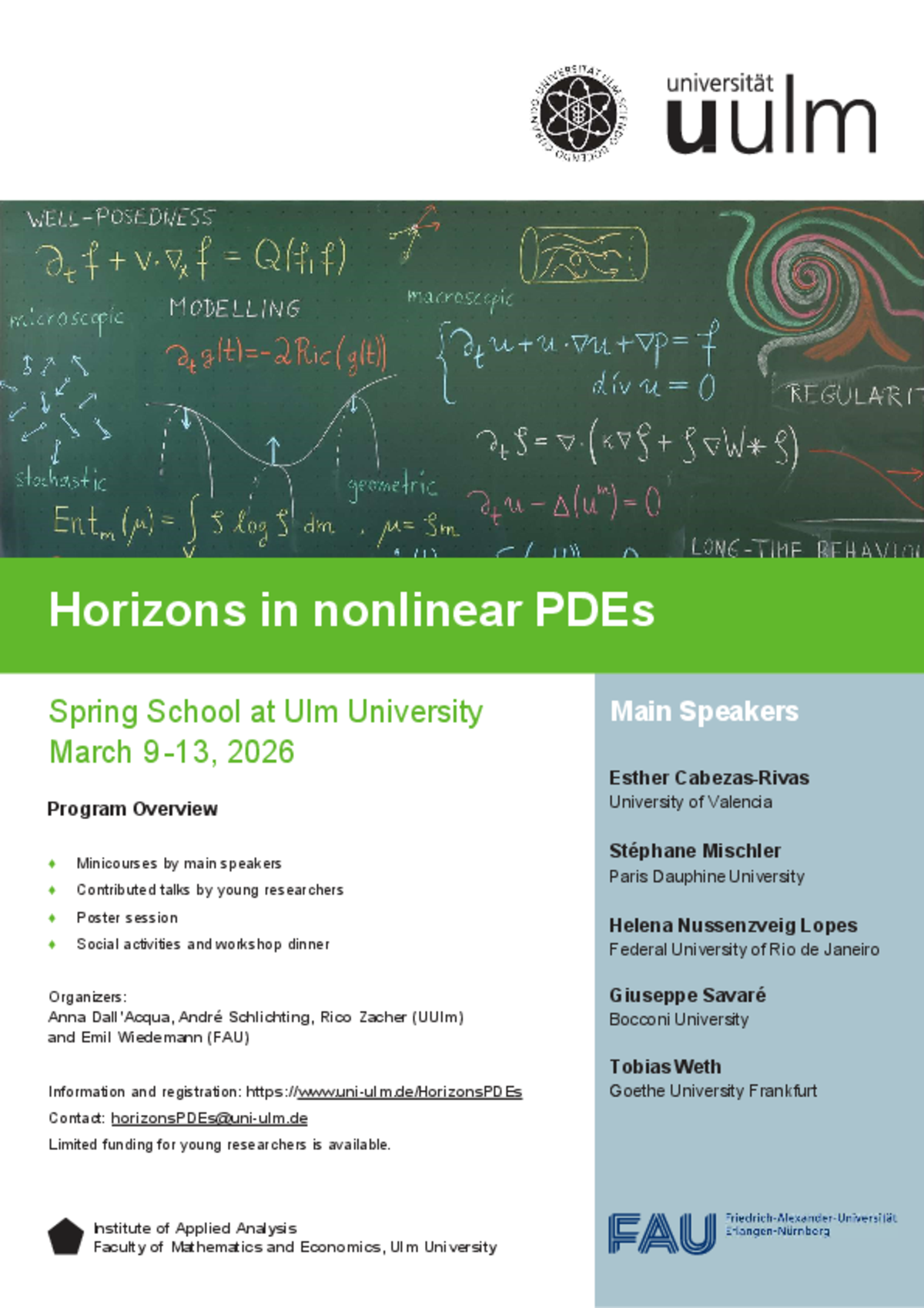
Poster
⚠️ Beware of travel scams! ⚠️
We got noticed about Emails sent to the speakers and participants from certain "travel agencies". Those are scams, and are not related to the workshop!
All Email are sent by the organizers, Ilaria Piacentini or from horizonsPDES[at]uni-ulm.de.
Registration
Deadline to apply for a talk and financial support or/and a poster was 15.11.25
No additional fees are requested.
Spring School Timetable
NB. The school will start on Monday morning and end on Friday at lunchtime.
Registration, participants and travel information
Registration is closed.
The final programme and Book of Abstracts are now online.
Please consult the booklet for the timetable, abstracts, practical information, venue maps and the final list of participants.
Other Informations
You may contact us per email under horizonsPDEs[at]uni-ulm.de
Discover what awaits you at the Spring School, including our social activities, on the Programme & Social Activities page.